
Howard Schultz and the Starbucks crisis of 2008
When Howard Schultz returned as CEO of Starbucks on January 8, 2008, the company he had built was unrecognizable.
 CEO.com
6 min read
CEO.com
6 min read
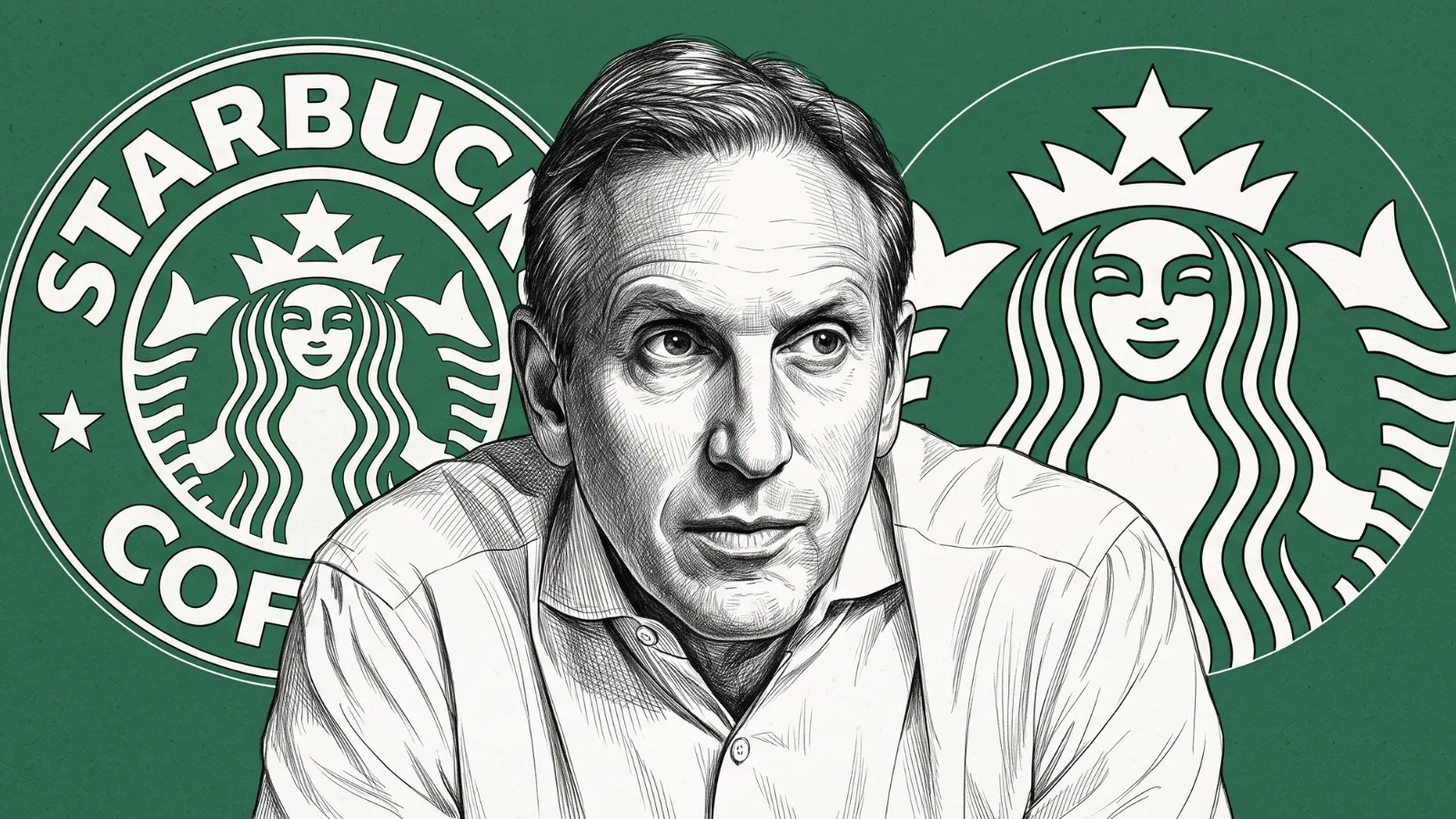
When Howard Schultz returned as CEO of Starbucks on January 8, 2008, the company he had built was unrecognizable. Same-store sales were declining for the first time in the company's history. The stock had lost roughly half its value from its 2006 peak. Profit had fallen 28 percent year over year. McDonald's was rolling out McCafé espresso bars in direct competition. And the worst financial crisis since the Great Depression was months away from hitting.
Schultz had stepped away from daily operations in 2000, handing the CEO role to successors who presided over explosive expansion. Between 2004 and 2008, Starbucks doubled its store count from roughly 8,500 to nearly 17,000 locations. But the growth masked a deeper rot. As a Harvard Business School case study on the turnaround later documented, the company had drifted from its core identity. Automated espresso machines replaced barista craft. Prepackaged food filled display cases. Stores that were meant to feel like neighborhood gathering places felt like chain restaurants. The company that Schultz had built around the concept of a "third place" between home and work had become, by his own admission, a soulless operation optimized for speed.
None of this was a secret to Schultz. Almost a year before his return, on Valentine's Day 2007, he had written an internal memo to then-CEO Jim Donald titled "The Commoditization of the Starbucks Experience." The memo was meant to be private. It was leaked to the internet within days.
What the Memo Revealed
The leaked memo, authenticated by The Wall Street Journal, was remarkable not for what it said but for who said it. This was the founder of the company acknowledging, in writing, that a decade of decisions made in pursuit of growth had diluted the very thing that made Starbucks worth building. He pointed to streamlined store designs that had stripped out warmth and character. He pointed to the tall automatic espresso machines that blocked the line of sight between barista and customer. He pointed to the sealed flavor-locked packaging that eliminated the aroma of fresh-ground coffee from the store experience.
As Nation's Restaurant News reported at the time, marketing strategist Al Ries called the memo courageous precisely because the company was not yet in crisis when it was written. Most executives wait until the numbers force their hand. Schultz wrote it while Starbucks was still posting revenue growth. He saw the erosion before the market did.
The memo was embarrassing in the moment. It rattled investors and gave competitors ammunition. But in retrospect, Schultz has said it served as a galvanizing force inside the company, forcing conversations that the leadership team had been avoiding.
The Decisions
When Schultz took back the CEO title in January 2008, he did not arrive with a fully formed plan. He arrived with clarity about what Starbucks had lost and a willingness to make decisions that served identity over short-term performance.
The first move was symbolic and practical at the same time. On February 26, 2008, Schultz closed all 7,100 U.S. stores for an evening to retrain 135,000 baristas on the craft of making espresso. The company lost over $6 million in revenue in a single night. Analysts called it reckless. Investors were already nervous. But Schultz understood that the retraining was not really about espresso technique. It was a declaration, both internal and external, that Starbucks would recommit to the experience that had built the brand, even at a measurable cost.
The second move was harder. He eliminated the breakfast sandwiches that stores had been selling. The sandwiches were profitable. Customers liked them. But the smell of heated cheese and egg was overpowering the aroma of coffee, and Schultz saw this as a physical manifestation of how the company had lost its way. In his book "Onward," he described the sandwich smell as one of the things that had most deeply frustrated him during his time away from operations. He ordered them removed, overruling the executive team. The sandwiches were eventually reformulated and brought back, but only after the smell problem was solved.
The third move was the most painful. In July 2008, Starbucks announced it would close 600 underperforming stores, affecting roughly 12,000 employees. As NPR reported, most of the targeted locations had opened since 2006, which meant the company was shutting down nearly one in five of all the stores it had built in the previous two years. In January 2009, Schultz closed an additional 300 stores and cut 7,000 positions. He took a salary reduction approved by the board.
Each of these decisions was made without certainty that it would work. Schultz did not know whether retraining baristas would actually change the customer experience. He did not know whether pulling the sandwiches would hurt sales more than it helped the brand. He did not know whether closing 600 stores was enough, or too many, or too few. What he had was not certainty. It was clarity about what Starbucks needed to stand for.
The Power of Public Honesty
What separates the Schultz turnaround from a standard corporate restructuring is the role that honesty played. In a moment when most CEOs were projecting confidence and blaming external conditions, Schultz stood in front of his employees and said the problems were self-inflicted. As BusinessToday documented in a case study on the crisis, the previous leadership team had blamed the economy and rising dairy costs for the slump. Schultz rejected that framing entirely. On his first day back, he told employees that the company should not blame external conditions for problems created by its own bureaucratic expansion.
This was not posturing. The NBC News/BusinessWeek profile of Schultz from 2009 described the atmosphere at Seattle headquarters in his first week back as "shell-shocked." Schultz was not gentle about it. He walked into a company that had forgotten what made it different and told them so. But he also told them he did not have every answer, that the turnaround would require the entire organization to rediscover what they stood for.
In March 2008, he launched "My Starbucks Idea," a platform that invited customers to tell the company directly what it was getting wrong. Over 93,000 ideas were submitted. More than 100 were implemented. The move was unusual for a public company in crisis. Most organizations in that position tighten control. Schultz opened the door wider.
The Results
By the second half of 2009, Starbucks had stabilized. Same-store sales turned positive. Customer satisfaction scores improved. The stock, which had bottomed near $7 a share, gained 143 percent in 2009. Annual profit climbed from $315 million in 2008 to $945 million in 2010, as Schultz later recounted to CNBC. Over the following years, the stock price appreciated more than 1,000 percent from its 2009 low.
Schultz stayed on as CEO until 2017, presiding over the launch of the mobile ordering platform, the expansion into China, and the development of the loyalty program that became an industry model. When he finally stepped away, Starbucks had more than 25,000 stores in 75 countries.
The Leadership Lesson
The Schultz turnaround is often studied as a case in operational execution. Close underperforming stores. Retrain employees. Refocus on core product. But those are the mechanics. The deeper lesson is about what made the mechanics possible.
Schultz could close 7,100 stores for an evening because he had first told the truth about why the stores needed closing. He could cut 600 locations because he had taken responsibility for the overexpansion that created them. He could ask 135,000 employees to recommit to the craft of making coffee because he had publicly admitted that the company's leadership, himself included, had allowed the craft to erode.
The honesty came first. The execution followed.
This matters for the current moment because the temptation facing most leaders right now is to project certainty they do not have. The market is volatile. Institutions are unreliable. AI is rewriting the economics of entire industries. The instinct is to have the answer, to present the plan, to show the board and the team that you know exactly what comes next.
Schultz's example suggests the opposite. When he returned to Starbucks in January 2008, he did not know exactly what came next. He knew what the company had to stand for. He knew which decisions were his to make. And he was honest, publicly, painfully honest, about what had gone wrong.
That honesty did not make him look weak. It gave everyone around him permission to stop pretending and start working on the actual problem.
In his book "Onward," Schultz wrote about the courage required to make choices that go against reason and the counsel of trusted advisors. The line that captures the turnaround best is his observation that Starbucks' success was never an entitlement. He had been saying it for twenty years before the crisis proved him right.
The leaders who will navigate the current uncertainty best are not the ones who pretend to have certainty. They are the ones who know what their company stands for, who take responsibility for the decisions that led to this moment, and who are willing to say, in front of everyone, that they do not have every answer. And then make the best decision available with what they do know.
That is personal leadership. Everything else is performance.