
Performing vs. leading
Nobody becomes a hollow leader all at once. It happens over coffee, between two jokes, in the jolliest, friendliest spirit.
 CEO.com
4 min read
CEO.com
4 min read
Boris Dubretskoi is a nobody. A second lieutenant. But within hours of arriving at military headquarters, he sees something most officers spend entire careers pretending doesn't exist: the real hierarchy has nothing to do with the one printed in the manual. A captain can make a general wait in the hallway. Rank is decoration. Proximity is power.
Boris doesn't resist this discovery. He doesn't report it. He leans into it. He decides, right there, to be guided by the invisible system. The one where power actually lives.
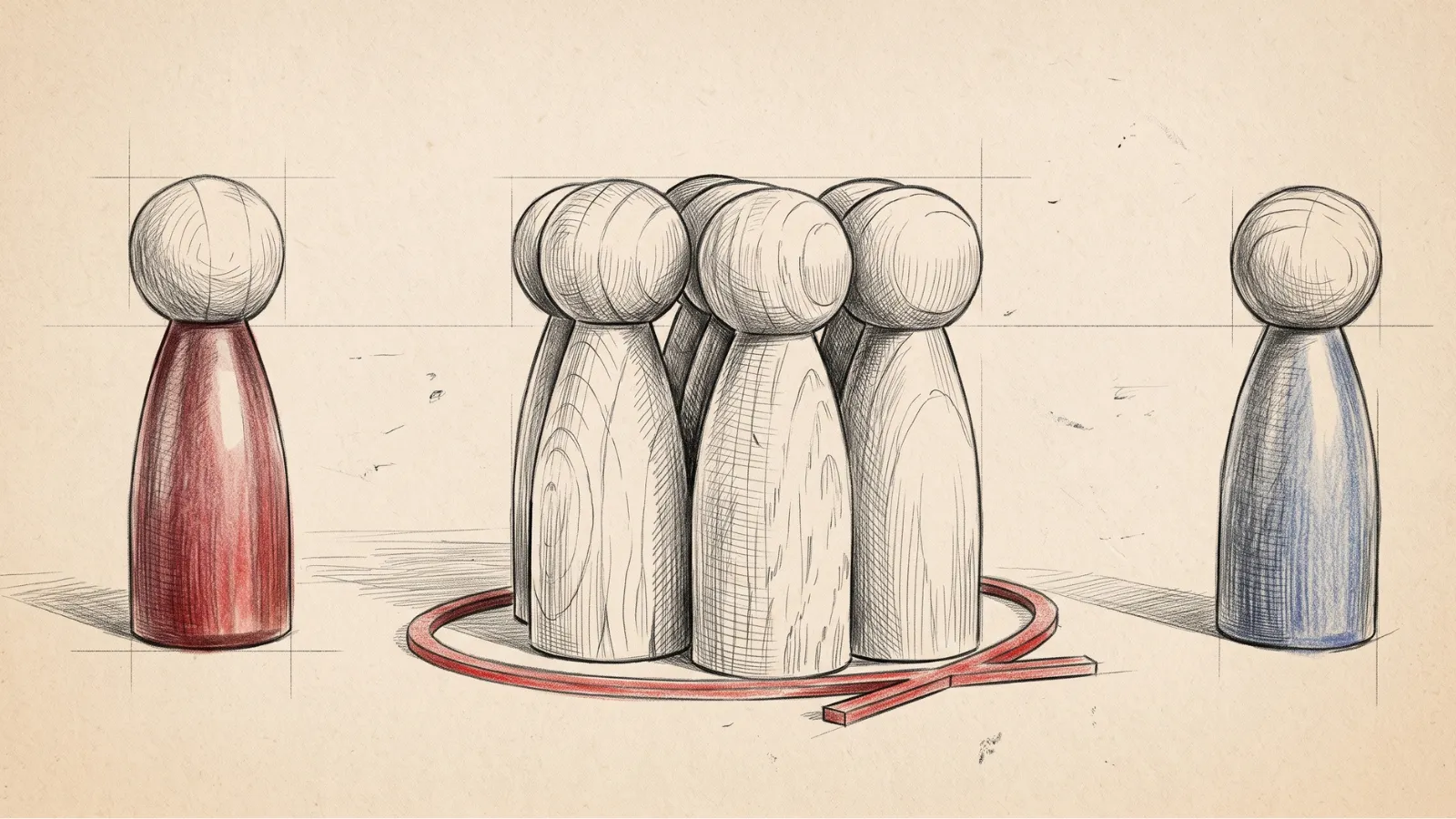
Tolstoy wrote that scene in War and Peace. C.S. Lewis loved it so much he opened one of his most important essays with it. He gave the invisible system a name: the Inner Ring. And then he made an argument that should unsettle every leader who encounters it.
The pull
The Inner Ring is not a conspiracy. It's a desire. The desire to be inside, to be one of the people who know, to hear someone use the word "we" and feel the warmth of inclusion. Lewis argued it is one of the most powerful forces in human behavior, and it operates most effectively when the person under its influence has no idea they're under its influence at all.
The pull never arrives as obvious corruption. It comes over coffee. Between two jokes. From someone you admire, at precisely the moment when you most want their approval. They say "we," and something lights up. You don't cross a line. You just lean toward the warmth.
This is how leaders stop leading and start performing.
The performance
The performed leader is oriented toward a Ring. Every decision comes down to a question that has nothing to do with the work: Am I in, or am I out? They learn the right language for the room. They learn which opinions are safe. They signal depth without committing to it. They look like they're making hard calls while deferring to whatever the Ring expects.
Here is the part Lewis understood that most leadership thinking misses: the performance never stabilizes. The Ring cannot hold you. "By the very act of admitting you," he wrote, "it has lost its magic." The moment you're in, you're already scanning for the next Ring. The one inside the one you just entered.
Performance is a sieve. You pour yourself through it, and nothing accumulates.
And the cost doesn't stop with the leader. The team learns to perform back. They start reading the room instead of doing the work. They learn which truths are welcome and which aren't worth the risk. An entire organization can become a hall of mirrors, every person reflecting what they think the person above them wants to see, until no one in the building is saying what they actually believe.
The fork
The distance between performing and leading rarely announces itself. Consider: a CEO hears through a back channel that a board member is quietly building support to replace the CFO with someone from their own network. The CFO is good. Not perfect, but solid and trusted by the team. The board member is influential and connected, and sits at the center of a Ring the CEO has spent years building relationships with.
The performed leader takes the meeting. Tests the water. Finds a way to frame the change as strategic rather than political. Tells the CFO it's about "fit" or "the next phase." Everyone in the room knows what actually happened, but the language is clean enough to maintain the fiction.
The enacted leader picks up the phone and tells the board member no.
That's the fork. It's not complicated. It's just expensive.
Lewis warned that each time someone takes the performance fork, the next one comes at a cheaper price. "Next week it will be something a little further from the rules, and next year something further still, but all in the jolliest, friendliest spirit." Nobody becomes a hollow leader all at once. It happens by tiny increments of choosing the Ring over the work, until the work is barely a memory.
The craftsmen
Lewis offered an alternative so simple it's easy to dismiss.
Make the work the point.
"If in your working hours you make the work your end," he wrote, "you will presently find yourself all unawares inside the only circle in your profession that really matters." You will be among the sound craftsmen. And other sound craftsmen will know it.
The sound craftsmen. Not the most visible leaders. Not the most connected. Not the ones collecting keynotes and board seats and magazine profiles. The ones who do the thing the role actually exists to do. The ones whose judgment is trusted not because of their title but because of a long, unglamorous track record of caring about getting it right.
The leaders who last have all been inside Rings. Most of them walked out. Some were pushed. All of them, at some point, made the same quiet decision: the work matters more than the room.
Lewis said this kind of belonging, the kind that forms around shared craft rather than shared exclusion, is the thing Aristotle called friendship. It causes "perhaps half of all the happiness in the world, and no Inner Ring can ever have it."
That is the whole difference between performing leadership and enacting it. One is a sieve. The other is a craft.