
Sam Altman and the evolution of OpenAI
OpenAI was founded as a non-profit research lab.
 CEO.com
13 min read
CEO.com
13 min read
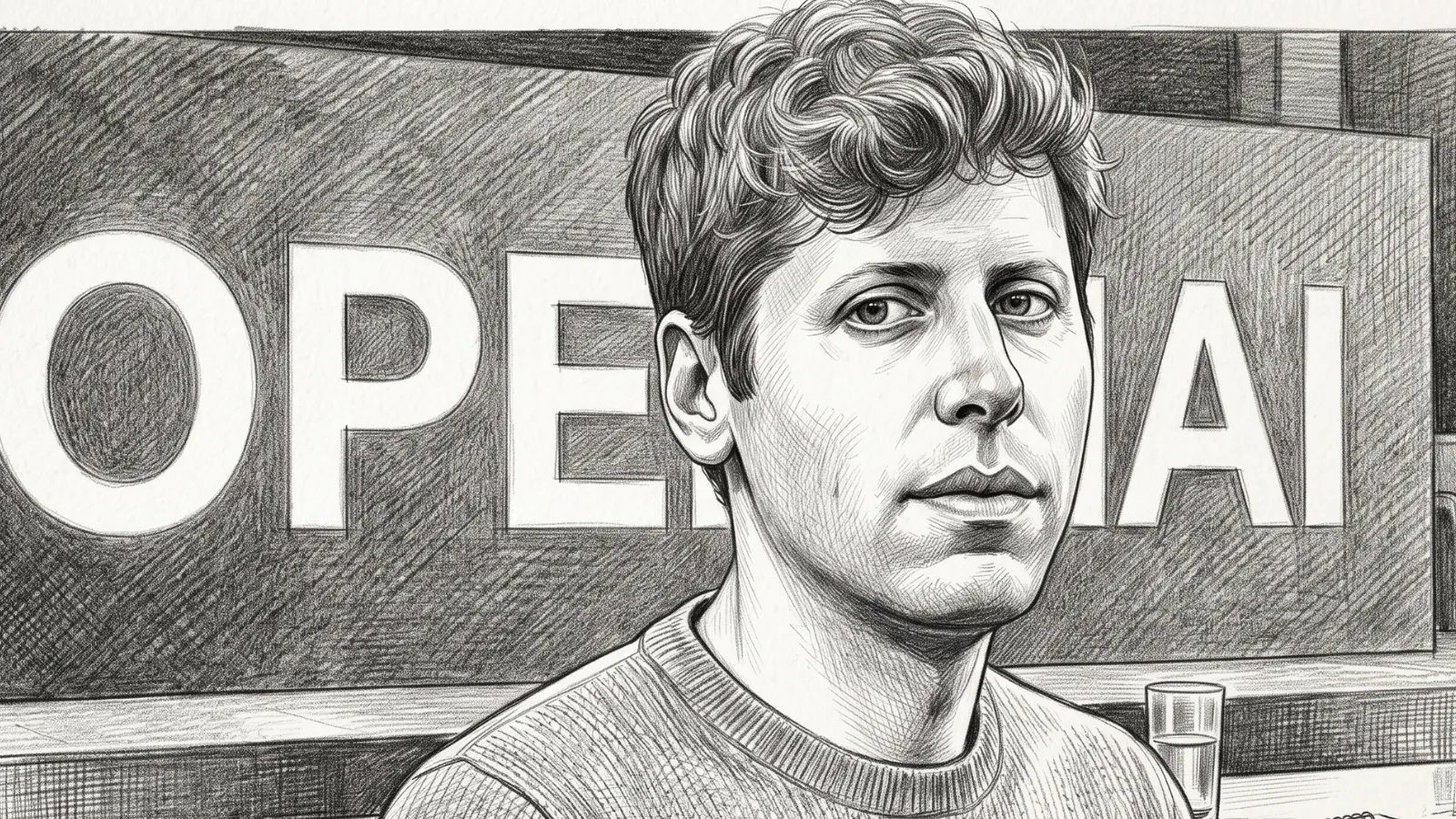
In December 2015, Sam Altman and Elon Musk met over dinner at the Rosewood Hotel in Silicon Valley to discuss a shared concern: artificial general intelligence in the wrong hands could be disastrous. From that conversation, OpenAI was born as a nonprofit with a mission statement that now seems like a relic from another time.
The organization stated it would "freely collaborate" with other institutions and researchers by making some of its patents and research open to the public. OpenAI was founded as a non-profit research lab. It was almost like an anti-Big Tech company; it would prioritize principles over profit. It wanted to, as OpenAI put it back then, develop AI tools that would "benefit humanity as a whole, unconstrained by a need to generate financial return."
Altman stated in 2015 that they were partly motivated by concerns about AI safety and existential risk from artificial general intelligence.
The founding team included luminaries willing to sacrifice lucrative positions elsewhere. OpenAI co-founder Wojciech Zaremba stated that he turned down "borderline crazy" offers of two to three times his market value to join OpenAI instead. A Google employee said he was willing to leave for OpenAI "partly because of the very strong group of people and, to a very large extent, because of its mission."
This was the invisible game made visible: a group of people who had defined their purpose clearly enough to resist financial incentives that would have swayed most.
The First Pivot: From Open to Closed
The original vision encountered an inconvenient reality: developing cutting-edge AI requires enormous resources. In 2018, two things happened: First, Musk quit the board of OpenAI after he said he invested $50 million, cutting the then-unknown company off from more of the entrepreneur's crucial financial backing. And secondly, OpenAI's leaders grew increasingly aware that developing and maintaining advanced artificial intelligence models required immense computing power, which was incredibly expensive.
A year after Musk left, OpenAI created a for-profit arm. The company established a "capped-profit" structure that limited investor returns to 100 times their investment, with a nonprofit board retaining ultimate control. During this pivotal moment of OpenAI, Sam Altman became its CEO.
This was the first compromise. Perhaps a necessary one. But it set a pattern.
Yet the nonprofit's board and mission still governed the company, creating two competing tribes within OpenAI: adherents to the serve-humanity-and-not-shareholders credo and those who subscribed to the more traditional Silicon Valley modus operandi of using investor money to release consumer products into the world as rapidly as possible in hopes of cornering a market and becoming an industry pacesetter.
The Public Testimony: May 2023
When Altman testified before the Senate Judiciary Committee in May 2023, he presented himself as a leader deeply concerned about the technology his own company was creating.
Altman urged lawmakers to regulate artificial intelligence during a Senate panel hearing, describing the technology's current boom as a potential "printing press moment" that requires safeguards. "We think that regulatory intervention by governments will be critical to mitigate the risks of increasingly powerful models," Altman said in his opening remarks.
Altman laid out a general three-point plan for how Congress could regulate AI creators. First, he supported the creation of a federal agency that can grant licenses to develop AI models with a certain threshold of capability and can also revoke those licenses if the models don't meet government-set safety guidelines.
The testimony was remarkable for how unusual it was: For what might be the first time ever, industry leaders of a new technological revolution are practically begging the government to regulate them.
The Kennedy Exchange: A Revealing Moment
One of the most revealing moments of that 2023 hearing came during an exchange with Senator John Kennedy of Louisiana. Kennedy, known for his folksy directness, cut through the rhetoric to ask practical questions.
"Permit me to share with you three hypotheses that I would like you to assume for the moment to be true," Kennedy began. "Hypothesis number one, many members of Congress do not understand artificial intelligence. Hypothesis number two, that absence of understanding may not prevent Congress from plunging in with enthusiasm and trying to regulate this technology in a way that could hurt this technology. Hypothesis number three, that I would like you to assume there is likely a berserk wing of the artificial intelligence community that intentionally or unintentionally could use artificial intelligence to kill all of us and hurt us the entire time that we are dying."
Kennedy then asked: "Please tell me in plain English two or three reforms, regulations, if any, that you would implement if you were queen or king for a day..."
Altman responded: "Number 1, I would form a new agency that licenses any effort above a certain scale of capabilities and can take that license away and ensure compliance with safety standards."
Kennedy followed up: "Would you be qualified to, if we promulgated those rules, to administer those rules?" After Altman said he loved his current job, Kennedy proceeded to ask Altman for suggestions about who else could run such an agency.
Then came the exchange that revealed something important about Altman's positioning:
"You make a lot of money. Do you?" Kennedy asked.
"I make no... I get paid enough for health insurance. I have no equity in OpenAI," Altman replied.
"Really?" Kennedy pressed. "That's interesting. You need a lawyer."
"I need a what?" Altman asked.
"You need a lawyer or an agent," Kennedy quipped.
"I'm doing this cuz I love it," Altman responded.
The exchange captured something essential: Altman presenting himself as a mission-driven leader, unburdened by financial incentives, asking to be regulated for the good of humanity. It was compelling. Senators were charmed.
But Kennedy's attitude perhaps indicated that senators, keen not to leave a transformational new technology almost entirely unregulated like they did during the era of social media, are perhaps over-correcting by being too credulous toward technologists' own views of how their tools should be regulated. "We can't really have the companies recommending the regulators," Gary Marcus, the AI professor, told TIME after the hearing. "What you don't want is regulatory capture, where the government just plays into the hands of the companies."
Some observers saw through it. "Sam Altman went in front of Congress and he said, basically begged them to protect the public from the technology that he is creating, which can seem a little weird if you take it at face value. One of the things that I think is interesting about this, it's actually not unusual for the tech industry to ask to be regulated. That's exactly what we've seen on privacy issues... It gives tech companies a huge advantage if there are laws that they can comply with. That way, if something goes wrong, they can just say, 'Oh well, we were following the rules.'"
The Worst Fear Question
During that same hearing, Professor Gary Marcus noted something telling. After Altman discussed his concerns about AI's impact on jobs, Marcus observed: "I will note that Sam's worst fear I do not think is employment. And he never told us what his worst fear actually is. And I think it's germane to find out."
When pressed, Altman responded: "My worst fears are that... we, the field, the technology, the industry, cause significant harm to the world. I think that could happen in a lot of different ways; it's why we started the company... I think if this technology goes wrong, it can go quite wrong, and we want to be vocal about that. We want to work with the government to prevent that from happening, but we try to be very clear eyed about what the downside case is and the work that we have to do to mitigate that."
It was a carefully worded answer. Sincere-sounding. But notably vague about what "significant harm" actually meant, and notably silent about whether the pursuit of competitive advantage and commercial success might itself be a source of that harm.
The Board Crisis: November 2023
Six months after that testimony about the importance of safety and oversight, the board, designed to provide exactly that oversight, fired Altman.
On November 17, 2023, at approximately noon PST, OpenAI's board of directors ousted Altman effective immediately following a "deliberative review process". The board concluded that Altman was not "consistently candid in his communications".
There was no single incident that precipitated Altman's ouster; rather, a growing sense among the board's majority that they couldn't trust Altman. Although there wasn't some massive recent leap in AI capability that precipitated the move, the board feels its primary job is safely developing ever more capable technology and felt it couldn't fulfill that mission if it couldn't trust what Altman was telling them.
Former board member Helen Toner later provided specifics: "For years, Sam had made it really difficult for the board to actually do that job by withholding information, misrepresenting things that were happening at the company, in some cases outright lying to the board."
One example she gave: When OpenAI released ChatGPT in November 2022, the board was not informed in advance and found out about it on Twitter.
Toner also said Altman did not tell the board he owned the OpenAI startup fund.
"The two of them suddenly started telling us... how they couldn't trust him, about the toxic atmosphere he was creating," Toner said. "They used the phrase 'psychological abuse,' telling us they didn't think he was the right person to lead the company to AGI, telling us they had no belief that he could or would change."
What happened next revealed where the real power lay. Altman was reinstated on November 22 after pressure from employees and investors. Nearly all of OpenAI's 770 employees signed a letter threatening to leave if Altman wasn't brought back. Microsoft, with $13 billion invested, applied pressure. A future OpenAI nonprofit board could decide that OpenAI-the-company wasn't staying true to its mission, and fire its leadership. We say "in theory" because in practice, Altman has made this scenario extremely unlikely. The nonprofit board is now much more tightly under his control.
The oversight mechanism designed to keep OpenAI true to its mission had been neutralized. The same man who had told Senator Kennedy he wanted an agency that could revoke licenses had just demonstrated that oversight of his own company could be overridden when it became inconvenient.
The Safety Team Exodus: 2024
The following year, the pattern continued. OpenAI's Superalignment team, created to address the long-term risks of superintelligent AI, was disbanded less than a year after its formation.
Immediately following the announcement by chief scientist Ilya Sutskever that he was leaving the company after almost a decade, his team partner and one of Time's 100 most important AI figures, Jan Leike, also announced he was quitting.
"Over the past years, safety culture and processes have taken a backseat to shiny products," Leike said in a thread on X. Leike criticized the ChatGPT maker for failing to invest enough computing resources in "figuring out how to steer and control AI systems much smarter than us."
"I joined because I thought OpenAI would be the best place in the world to do this research," Leike wrote on X. "However, I have been disagreeing with OpenAI leadership about the company's core priorities for quite some time, until we finally reached a breaking point."
As of last summer, half of the OpenAI staff that once focused on the long-term risks of superpowerful AI had left the company, including cofounder and chief scientist Ilya Sutskever. Nearly 20% of the company now works in sales.
The Testimony Reversal: May 2025
Two years after urging Congress to create an AI licensing agency, Altman returned to Capitol Hill with a strikingly different message.
Sam Altman, CEO of ChatGPT-maker OpenAI, warned at a Senate hearing Thursday that requiring government approval to release powerful artificial intelligence software would be "disastrous" for the United States' lead in the technology. It was a striking reversal of his comments at a Senate hearing two years ago, when he listed creating a new agency to license the technology as his "number one" recommendation to ensure AI was safe.
Altman repeatedly rejected specific calls for regulation. He said proposals requiring AI developers to vet their systems before rolling them out would be "disastrous" for the industry. Asked about more limited proposals to have the National Institute of Standards and Technology (NIST) set AI standards, Altman replied, "I don't think we need it. It can be helpful." Altman later advocated for "sensible regulation that does not slow us down."
There was, however, a notable absence of references to AI safety in Altman's testimony, in stark contrast to his 2023 comments, which mentioned AI safety dozens of times.
Remember: this was the same person who had told Senator Kennedy, under oath, that his "number one" priority would be to form an agency that licenses AI efforts and can revoke those licenses. The same person who said he wanted to work with government to prevent AI from causing "significant harm to the world."
The Conversion: From Nonprofit to For-Profit
The final step was converting the company in its entirety. When OpenAI was founded in 2015, its mission was clear and ambitious: to develop artificial intelligence that benefits all of humanity, free from commercial constraints. Co-founders Elon Musk and Sam Altman envisioned an organization that would advance digital intelligence for the public good, prioritizing safety and accessibility over profit. However, recent developments reveal that this lofty goal has been abandoned. On 28 October 2025, OpenAI announced a sweeping transformation: the once non-profit entity is now a for-profit corporation.
After nearly a year of negotiations, OpenAI announced that it has completed its transformation into a public benefit corporation, with a separate nonprofit Foundation focused on "health and curing diseases" and "technical solutions to AI resilience" holding a $130 billion stake in the for-profit arm. That’s just shy of the $135 billion stake that Microsoft received, which it said represented 27% ownership.
The original mission — to develop AI "unconstrained by a need to generate financial return" — had been formally abandoned.
The Equity Question
Throughout this transformation, Altman maintained that he held no equity in OpenAI. This was central to his narrative of being motivated by mission rather than money. The same narrative he presented to Senator Kennedy.
The answer he gave on stage Thursday, and in March during an interview with the New York Times, is that he holds no stake in OpenAI. "I have like wondered if I should, like, just take one share of equity so I never have to answer this question again," Altman said.
"This is my childhood dream job," said Altman, 39. "Getting to work on [artificial general intelligence] and...getting to sit in the room with the smartest researchers in the world and go on this crazy adventure, like that is what I always wanted to do."
But the no-equity claim became more complicated. Altman recently said he actually did have some equity in OpenAI through a Sequoia fund at one point, a stake he has since sold.
And there were other concerns. In May 2024, after OpenAI's non-disparagement agreements were exposed, Altman was accused of lying when claiming to have been unaware of the equity cancellation provision for departing employees who don't sign the agreement.
OpenAI CEO Sam Altman will not receive any equity in the company following a sweeping restructuring plan that gives Microsoft a significant ownership stake. The announcement resolves a major debate about OpenAI's development and indicates that Altman will continue to lead the company without holding direct ownership. This is a rare situation for a CEO at the helm of one of the tech industry's most valuable companies.
The Personal Leadership Question
What does any of this have to do with personal leadership?
Everything.
Personal leadership requires knowing your values and living by them. It requires defining success for yourself before external pressures define it for you. It requires the courage to say no to opportunities that conflict with your purpose, even when they're lucrative or prestigious.
The question with Altman is not whether he's intelligent or ambitious or capable. He clearly is all three. The question is whether he has defined his values with sufficient clarity to guide decisions when they become hard.
Consider the pattern:
He co-founded a nonprofit to ensure AI would benefit humanity, then converted it to a for-profit company.
He testified before Congress that government licensing of AI would be critical for safety — his "number one" priority if he were "king for a day" — then testified two years later that such licensing would be "disastrous."
He told Senator Kennedy he made no money and had no equity because he was "doing this cuz I love it," while the organization he led was laying the groundwork for one of the largest corporate restructurings in tech history.
He led an organization whose stated purpose was safety-first AI development, while safety researchers left in droves, saying the company had deprioritized their work.
He was fired by a board designed to keep the organization true to its mission, then returned with that board's power effectively neutralized.
Each of these could be defended individually. Circumstances change. Competition intensifies. Pragmatism matters. You could argue that Altman was simply adapting to reality, doing what was necessary to keep OpenAI competitive in a rapidly evolving landscape.
But that's exactly the point.
The question isn't whether these pivots were strategically sound. The question is whether they were anchored in any purpose beyond winning. Whether there was ever a line that wouldn't be crossed. Whether the original mission was a genuine commitment or a useful narrative that could be discarded when it became inconvenient.
Clayton Christensen warned that if you don't consciously decide what matters most, you will unconsciously drift into living by someone else's values. You'll optimize for metrics that feel important in the moment but don't add up to anything you actually wanted.
OpenAI's metrics look spectacular. The company is valued at hundreds of billions of dollars. ChatGPT has hundreds of millions of users. Altman is one of the most powerful figures in technology.
But the mission to develop AI that benefits humanity, unconstrained by financial return? The commitment to safety over speed? The nonprofit governance designed to prevent exactly the kind of profit-driven decision-making that now characterizes the company? The licensing agency he told Senator Kennedy was his top priority?
Those are gone. And perhaps they were always going to be gone. Perhaps the original mission was never realistic, given the capital requirements of AI development. Perhaps Altman is simply the CEO who did what needed to be done.
But that's a story about corporate strategy. It's not a story about personal leadership.
Personal leadership would have looked different. It might have meant walking away when the mission became untenable. It might have meant being honest with the board and public, even when honesty was inconvenient. It might have meant prioritizing the safety team's work even when it slowed product releases. It might have meant testifying consistently before Congress rather than shifting positions to match the political winds.
Most importantly, it would have meant defining success in terms that didn't require abandoning the original purpose.
What This Means for You
If you're a CEO reading this case study, the point isn't to condemn Sam Altman. He's navigating pressures most of us will never face, making decisions with consequences most of us can't imagine.
The point is to see clearly what happens when purpose becomes subordinate to momentum. When the visible game — the metrics, the valuation, the headlines — becomes more real than the invisible game.
Altman once told an interviewer about his motivation: "I believed before then, I believed then I believe now, that if we could figure out how to build AGI and if we could figure out how to make it a net good force in the world, it would be one of the most exciting, interesting, impactful, positive things anybody could ever do."
There's no reason to doubt that he believed this when he said it. The question is whether "make it a net good force in the world" was ever defined clearly enough to guide actual decisions. Whether it was a genuine constraint or an aspiration that could be deferred indefinitely in the name of competitive necessity.
This is the work of personal leadership: defining your values with enough precision that they actually constrain your behavior. Not someday. Today.
Because if you wait until the pressure is on to figure out what you actually believe, you'll discover that the pressure has already decided for you.