
Satya Nadella and the cultural transformation of Microsoft
By 2012, Microsoft's stock price had been essentially flat for a decade.
 CEO.com
7 min read
CEO.com
7 min read
In the summer of 2012, Kurt Eichenwald published an article in Vanity Fair titled "Microsoft's Lost Decade." Eichenwald had interviewed dozens of current and former Microsoft employees, and his conclusion was blunt: the company that had once defined the technology industry had turned inward, bureaucratic, and culturally toxic. At the center of the dysfunction was a management system called stack ranking, which forced every team to sort its members along a bell curve. A fixed percentage had to be rated top performers. A fixed percentage had to be rated poor. It did not matter how good the team was. Someone had to lose.
The consequences were predictable. Employees hoarded information. Collaboration became a liability, because helping a teammate succeed could mean pushing yourself down the curve. A former software developer told Eichenwald that the system led employees to focus on competing with each other rather than competing with other companies. Another described giving "the appearance of being courteous while withholding just enough information from colleagues" to protect his own ranking. Top engineers avoided joining teams with other top engineers, because the math of the bell curve meant that the better your colleagues were, the more likely you were to be ranked as average or below.
The system created a culture of fear. Not the productive kind. The kind that makes people small.
By 2012, Microsoft's stock price had been essentially flat for a decade. The company had missed mobile. It was late to cloud computing. It had the talent and the resources to compete in every major technology shift of the 2000s, and it lost ground in nearly all of them. Not because the engineers weren't capable. Because the culture made it irrational to take risks, to collaborate, to do the kind of work that produces breakthroughs.
Microsoft's market capitalization when Eichenwald's article was published: roughly $257 billion.
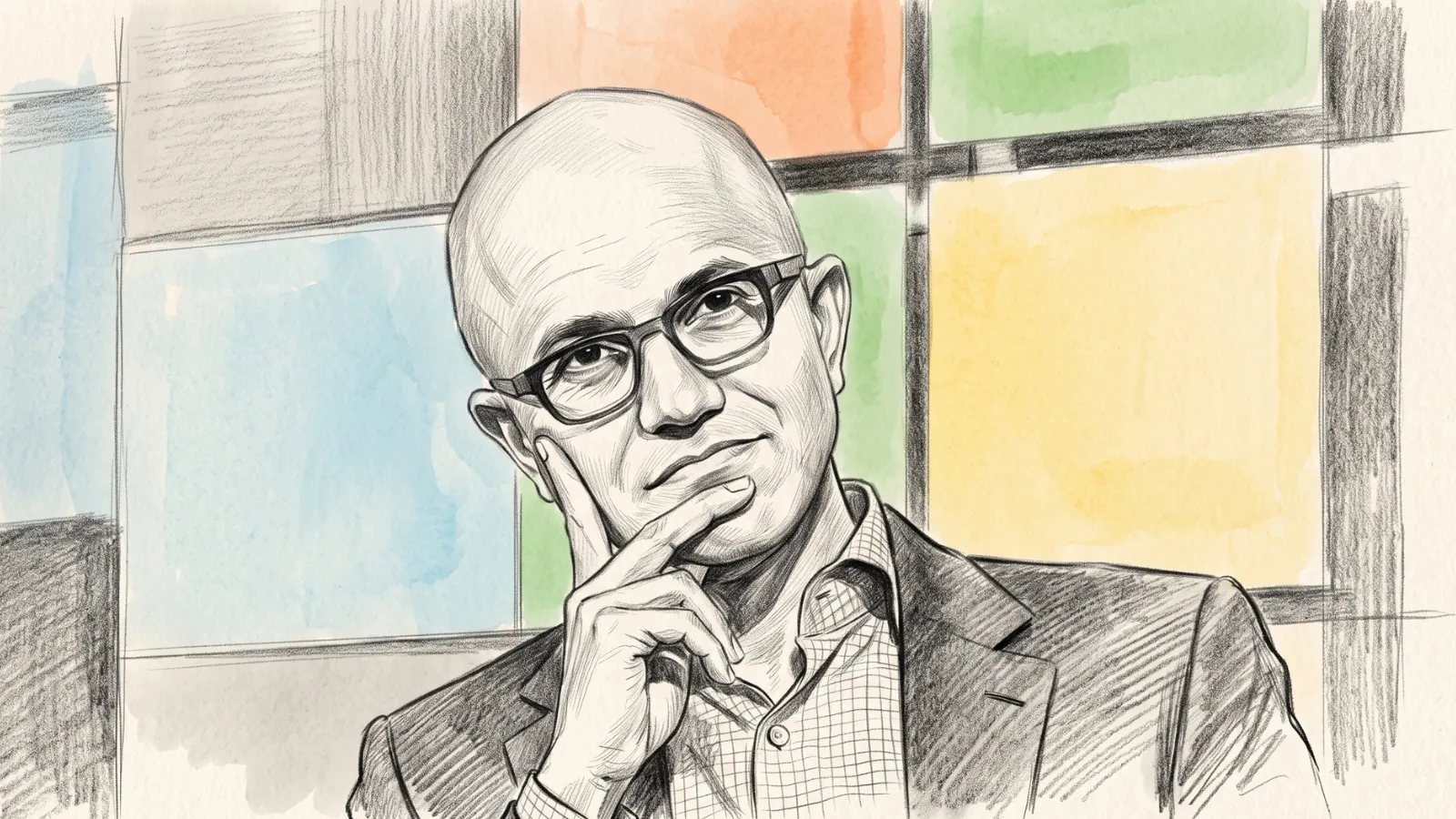
On February 4, 2014, Satya Nadella sent his first email as CEO to every employee at Microsoft. He was the company's third chief executive, following Bill Gates and Steve Ballmer. He had been at Microsoft for 22 years. He was not an outsider. He knew exactly what was broken.
The email contained a line that would define his tenure: "Our industry does not respect tradition. It only respects innovation."
But what Nadella did first was not a technology play. It was a people play.
The stack ranking system had technically been eliminated in November 2013, shortly before Ballmer's departure, after the Vanity Fair piece had made the practice indefensible in public. But killing the system was not the same as killing what the system had created. A decade of forced ranking had produced a culture where self-protection was the default behavior, where showing vulnerability was dangerous, and where the phrase "not invented here" was the unofficial company policy.
Nadella understood that changing the org chart or the performance review form would not be enough. He had to change how people felt about coming to work.
The framework he chose came from an unlikely source. In early 2015, Nadella's wife Anu gave him a book by Stanford psychologist Carol Dweck called Mindset: The New Psychology of Success. Dweck's research distinguished between what she called a fixed mindset, the belief that abilities are innate and static, and a growth mindset, the belief that abilities can be developed through effort and learning. People with fixed mindsets avoid challenges because failure threatens their identity. People with growth mindsets seek challenges because failure is information.
Nadella made the book required reading for his senior leadership team. For the broader organization, he distilled the idea into a phrase designed to travel: Microsoft would shift from being a company of "know-it-alls" to a company of "learn-it-alls."
Six words. But the behavioral implications were enormous. Under the old culture, admitting you didn't know something was weakness. Under the new one, it was the expectation. Under the old culture, asking for help meant you couldn't handle your job. Under the new one, leveraging other people's work was an explicit criterion in your performance review. Under the old culture, failure was career-threatening. Under the new one, it was supposed to be a data point.
Nadella didn't just announce this. He modeled it. He changed how the senior leadership team meetings ran. Previously, these sessions were described by participants as gladiatorial combat, where executives competed to demonstrate they had the best numbers and the sharpest insights. Nadella turned them into collaborative sessions where leaders were expected to share what they had learned, not what they had accomplished. He asked questions instead of giving answers. He made vulnerability safe at the top of the organization, because he knew it would never be safe at the bottom if it wasn't safe at the top.
The new performance system reflected this philosophy. Microsoft replaced stack ranking with a framework built around three dimensions: your individual impact, how you contributed to others' success, and how you leveraged the work of others. Two of the three criteria were explicitly about collaboration. The message was structural, not just rhetorical: you could no longer succeed at Microsoft by hoarding.
The cultural work was not a parallel initiative to the technology strategy. It was the prerequisite for it.
When Nadella took over, Microsoft's future depended on a massive pivot to cloud computing. Azure existed but was not yet a serious competitor to Amazon Web Services. The pivot required something that the old Microsoft was incapable of producing: cross-team collaboration at scale, willingness to cannibalize existing products, comfort with releasing imperfect software and iterating, and openness to building for platforms Microsoft did not control, including Linux, iOS, and Android.
None of that was possible in a culture where teams were at war with each other and where admitting your product was imperfect was a career risk.
One of Nadella's first major product decisions made this concrete. He launched Microsoft Office on Apple's iPad, a move that would have been unthinkable under Ballmer, who had insisted that everything revolve around Windows. The decision signaled something beyond product strategy. It told employees that the old sacred cows were gone. That the company would go where customers were, even if it meant abandoning positions that previous leadership had treated as non-negotiable.
Azure grew. Microsoft Teams was built through the kind of cross-divisional collaboration that stack ranking had made impossible. The company acquired LinkedIn, GitHub, Nuance, and Activision Blizzard, each acquisition requiring the cultural capacity to integrate outside talent and ideas rather than rejecting them. When the OpenAI partnership emerged, Microsoft was positioned to act on it because the organization had spent years building the internal trust and cross-functional agility that a bet of that magnitude requires.
The numbers tell the story. Microsoft's market capitalization when Nadella became CEO in February 2014: approximately $300 billion. By late 2024, it had exceeded $3 trillion. A tenfold increase. The largest value creation by a single CEO in corporate history.
The conventional reading of this story is that Nadella was a brilliant technology strategist who made the right bets on cloud and AI. That is true. But it misses the causal chain. Nadella could not have made those bets work without first building a culture that could execute them. The strategy required collaboration. Collaboration required trust. Trust required dismantling a system that had made fear the organizing principle of the company for over a decade.
The people strategy came first. The technology strategy was built on top of it. The market cap was a consequence of both.
This distinction matters because it is precisely the distinction most companies are getting wrong right now.
Microsoft stock is down roughly 25% from its 52-week high. In late January, the company lost $357 billion in market value in a single day after an earnings report that showed strong revenue growth but massive AI infrastructure spending that spooked investors. The broader $2 trillion software selloff has hit Microsoft along with the rest of the sector.
The question is whether the culture Nadella built is resilient enough to navigate another period of massive uncertainty.
The early evidence suggests it is, and for a specific reason: Microsoft has been through a version of this before. In 2014, the company faced an existential question about whether it could survive the shift from desktop software to cloud computing. The pivot required employees to accept that the work they had been doing might become less important, that the skills they had built might need to change, that the company they had joined was going to become a fundamentally different organization. Nadella's cultural work gave people a framework for processing that uncertainty without checking out or leaving.
The growth mindset framework is not just corporate philosophy. It is infrastructure. It gives employees a language for talking about change that does not reduce them to cost lines. It makes learning and adaptation the expected response to disruption, not a threat to identity. It creates space for the question that every employee is asking right now, "Am I going to be replaced?", to be asked out loud, examined honestly, and addressed as a shared challenge rather than a private fear.
Whether that infrastructure holds through the current AI transition is not guaranteed. But the contrast with companies that have no such infrastructure is stark. Microsoft employees have a decade of cultural evidence that their leadership sees them as people to be developed, not expenses to be optimized. That evidence is the kind of thing that keeps top performers from leaving when the market gets turbulent. It is the kind of thing that keeps people engaged when the ground is shifting under them. It is the kind of thing that makes the difference between an AI transformation that works and one that produces the illusion of efficiency while the actual quality of work quietly degrades.
The lesson of the Nadella case is not that culture is more important than technology. It is that they are the same thing. You cannot execute a technology strategy without the people who will build it, maintain it, improve it, and catch it when it is wrong. And you cannot retain those people, much less earn their best work, if they are afraid.
In Chekhov's story, Tchervyakov dies because no one in a position of authority engages with his fear honestly. The general dismisses him. Forget about it. It's nothing.
Nadella did the opposite. He looked at a company full of people who were afraid of each other, afraid of their own performance reviews, afraid to collaborate and afraid to fail, and he named it. He said: this is what we are, and this is what we need to become. He didn't promise that the transition would be painless. He didn't guarantee anyone's job. He changed the conditions that had made fear the rational response.
That is the work. It was the work in 2014, and it is the work right now.