
The bill comes due
For the first time, a jury ruled that the architecture of a social media platform is a defective product.
 CEO.com
10 min read
CEO.com
10 min read
In 1762, a French philosopher named Jean-Jacques Rousseau published a book that got him banned from Paris and Geneva simultaneously. The book was called Émile, or On Education. Authorities burned it in the streets. It went on to change how the Western world thinks about childhood.
Rousseau's argument was simple and radical. Children are born good. Society corrupts them. The job of a parent or teacher is not to fill a child with knowledge. It is to protect them from harm long enough for their own reason to develop.
He called this Negative Education. Not negative as in harmful. Negative as in protective. As in clearing the space around a child rather than cramming it full.
He wrote: "The first education, then, ought to be purely negative. It consists not at all in teaching virtue or truth, but in shielding the heart from vice and the mind from error."
His fictional student, Émile, is raised in the French countryside. No books until age 12. No formal lessons. No exposure to the vanity and competition of Paris. The child learns through his senses, through physical experience, through direct contact with the natural world. If he breaks a window, Rousseau does not lecture him on property rights. He lets him feel the cold wind come through the broken pane. The environment teaches. The adult protects.
The thing Rousseau feared most was what he called social contagion. He believed that exposing a child too early to the machinery of adult society, its competitions, its vanity, its relentless pressure to perform and compare, would corrupt the child before they had the inner resources to resist it. The harm was not dramatic. It was cumulative. A slow, invisible pressure applied before the child's heart and mind were ready to process it.
He was not describing a technology that existed. He was describing one that would be invented 262 years later, refined over roughly a decade, and placed into the hands of children as young as six.
What Rousseau feared was a system specifically engineered to maximize the time a child spent inside it. A system that replaced the countryside with a feed. That replaced physical sensation with a notification. That replaced a child's developing sense of self with an infinite scroll of other people's curated lives. That discovered through its own internal research that 11-year-old girls were its most reliable returning users and treated it as a product milestone rather than a warning sign.
He believed that any adult who understood this and allowed it to happen anyway was not making a passive omission. It was an active harm.
On March 25, 2026, a jury in Los Angeles agreed.
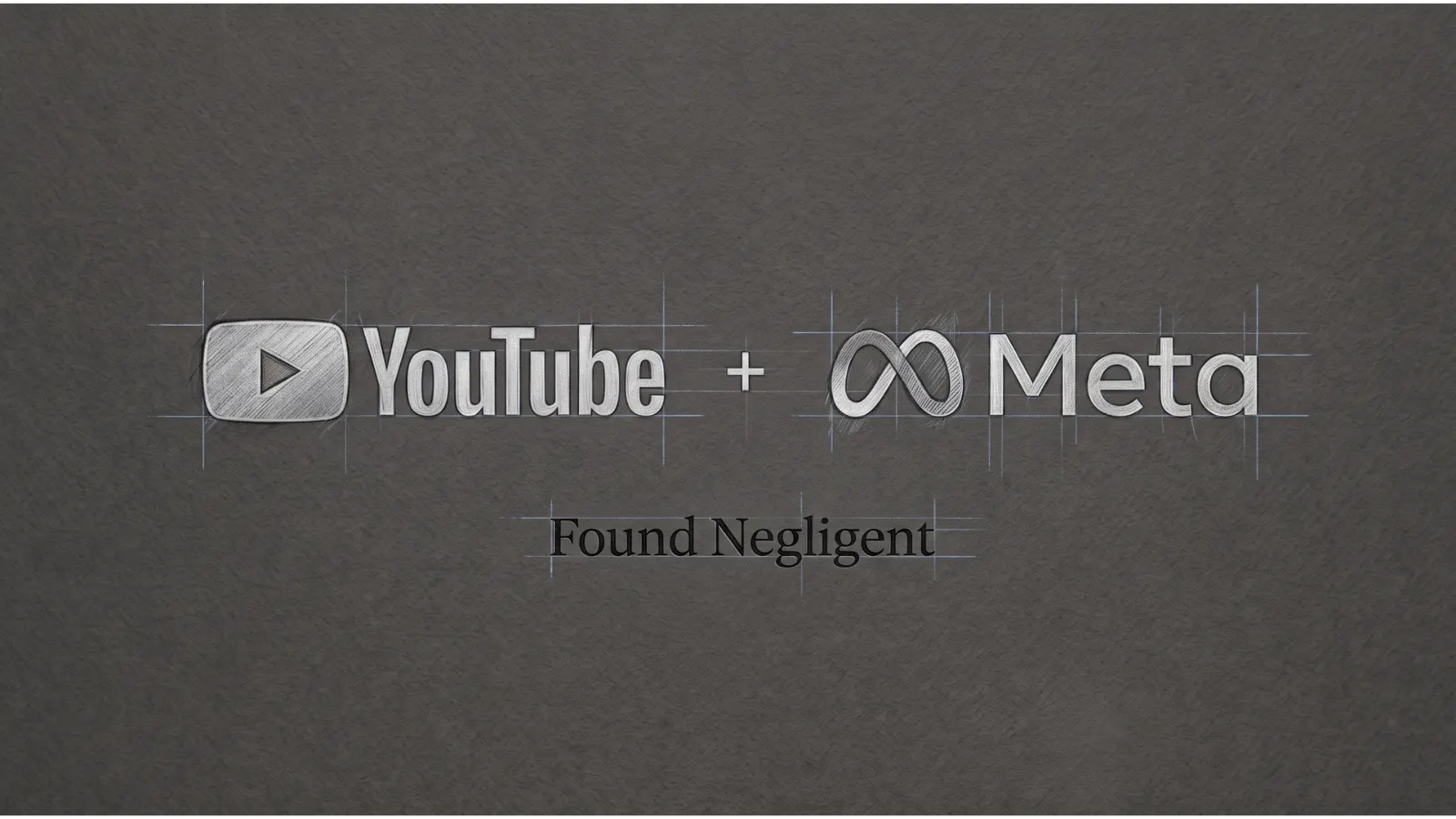
The verdict itself was straightforward. A jury of twelve people found Meta and YouTube liable on all counts in a case accusing the companies of deliberately designing their platforms to addict a child and damage her mental health. Total damages came to $6 million. That number will not register on any earnings call either company has ever held.
What will register is the legal theory the verdict validated.
For the first time in history, a jury held that the architecture of a social media platform, not the content on it, constitutes a defective product. The plaintiff's lawyers argued that it was not what Kaley saw on Instagram that harmed her. It was the way Instagram was built. Infinite scroll. Autoplay. Notification systems calibrated to create urgency. Beauty filters that, according to 18 external experts Meta had consulted, raised serious concerns about harm to young girls. Features the company understood, evaluated, and kept.
That is a different kind of ruling. It does not ask what a child was exposed to. It asks who designed the exposure mechanism and whether they knew what it would do.
The case centered on a 20-year-old woman from Chico, California, known in court as Kaley. She started using YouTube at age 6. Instagram at age 9. By the time she was a teenager, she spent more than 16 hours on Instagram in a single day. She developed anxiety, body dysmorphia, and suicidal thoughts. Her mother tried to intervene. The algorithm was more persistent than her mother.
Meta bears 70 percent of the liability. YouTube, 30. Both companies said they will appeal. Both said they disagree with the verdict. Neither said they would change anything.
This verdict did not arrive alone. One day earlier, a New Mexico jury found Meta liable for knowingly harming children's mental health and concealing what it knew about child sexual exploitation on its platforms. That jury ordered Meta to pay $375 million. Two verdicts in two days. They are the first of what could be thousands.
There are currently 2,407 pending lawsuits in federal multi-district litigation against social media companies. More than 10,000 individual cases. Nearly 800 school district claims. Over 40 state attorneys general have sued Meta alone. The lawyers involved now compare this wave to the tobacco litigation of the 1990s. That comparison is not rhetoric. It is a timeline.
The companies have long argued that the science does not support a link between their platforms and mental health harm in children. Mark Zuckerberg has said this in Congress, in interviews, and under oath in Los Angeles. The existing body of scientific work, he has said repeatedly, has not proved that social media causes mental health harms.
He is not entirely wrong. And that partial truth is precisely the problem.
Rates of depression among U.S. teenagers rose 106 percent between 2010 and 2020. Anxiety rose 134 percent in the same period. Those numbers did not drift upward gradually over decades. They spiked. The inflection point was around 2012, when Instagram's user base exploded from 10 million to 90 million, the front-facing camera became standard, and the platforms that social psychologist Jonathan Haidt has studied exhaustively began their full penetration of adolescent life. The same pattern showed up in the UK, Canada, and across Western Europe. This was not a local phenomenon.
The gender divide in the data is not subtle. A 2024 Pew Research survey found that 34 percent of teen girls say social media makes them feel worse about their own lives, compared with 20 percent of boys. Girls report more pressure to post, more exposure to content that triggers comparison, more sleep disruption, and more anxiety about appearance. These are not mysterious findings. They describe what happens when you take a developing adolescent girl, place her inside a system that ranks her photographs and quantifies her social standing in real time, and then calibrate that system to keep her inside it as long as possible.
A 2024 systematic review drawing on nearly 15 years of research found that excessive social media use is associated with impaired attention, reduced working memory, and diminished executive functioning. A separate review found that increased screen time correlates with altered neural development in areas governing social cognition. Rousseau believed the years before adolescence were the critical window for a child's reason to develop free from external pressure. Neuroscience now has a name for what he was describing. These reviews suggest the platforms may be reshaping that window from the inside.
Not everyone agrees on how much of the causation runs directly from platform to harm. Developmental psychologist Candice Odgers of UC Irvine, reviewing hundreds of studies, found a "mix of no, small and mixed associations" and argued that young people with existing mental health problems may simply be heavier users of platforms, not the other way around. That is a serious argument from a serious researcher, and it deserves to be taken seriously.
But the scientific debate and the legal question are different questions. The legal question is not whether the science is settled. The legal question is what these companies knew, when they knew it, and what they chose to do with that knowledge.
On that question, the internal documents introduced at trial are not ambiguous. A 2022 internal document projected that average time spent on Instagram would increase from 40 minutes per day to 46 minutes per day by 2026. Another showed that 11-year-olds were four times more likely to return to Instagram than to competing apps, despite the platform requiring users to be 13 or older. One internal review estimated that more than 4 million children under 13 were using Instagram in 2015. One document stated the company's ambition plainly: "If we wanna win big with teens, we must bring them in as tweens." An internal email cited in the New Mexico trial showed a Meta employee writing that informing parents about what their children were viewing on the platform would "ruin the product from the start."
This is not a company wrestling with uncertainty. This is a company that understood exactly what it had built, who was using it, and how young they were; received warnings from its own safety teams; and chose growth. Rousseau's fear was not abstract. It was this. An adult institution, with full knowledge of a child's vulnerability, deciding that vulnerability was a feature.
Mark Zuckerberg has now stood before a U.S. Senate committee and a Los Angeles jury and said essentially the same thing both times. The platforms are not addictive by design. The science is inconclusive. Meta has invested more in child safety than any company in the world. And, when pressed, he is sorry for what these families have been through.
The moment at the 2024 Senate hearing has been replayed many times. Sen. Josh Hawley challenged Zuckerberg to face the parents in the gallery, parents who believed their children had been harmed or killed because of his platforms. Zuckerberg stood, turned away from the microphone, and addressed them directly.
"I'm sorry for everything you've all gone through. No one should have to go through the things that your families have suffered. This is why we invest so much and are going to continue doing industry-leading efforts to make sure that no one has to go through the types of things that your families have had to suffer."
He apologized for their suffering. He did not accept responsibility for its cause. That is a precise and deliberate distinction, and he has maintained it in every forum since.
In the Los Angeles courtroom, under oath, he said: "I'm focused on building a community that is sustainable. If you do something that's not good for people, maybe they'll spend more time short term, but if they're not happy with it, they're not going to use it over time."
That is a reasonable-sounding sentence. It is also directly contradicted by a decade of internal documents showing the company tracked, measured, and optimized for the time spent by users who were not old enough to be on the platform at all.
The jury deliberated for 43 hours. They found him liable.
Neal Mohan, who became YouTube's CEO in 2023 and was named TIME's CEO of the Year for 2025, has been quieter on this subject. YouTube's defense throughout the trial rested on a single argument: YouTube is a streaming platform, not a social media site, and the case misunderstands the product. YouTube's CEO was not called to testify.
In his 2024 annual letter, Mohan wrote that creating a healthy online experience for kids is important and that YouTube supports the growth of kids and teens "thoughtfully and in coordination with parenting and mental health experts." That is a corporate sentence. It does not say much.
What says more is what both men do at home.
In December 2025, just weeks before the Los Angeles trial began, Mohan told TIME Magazine that he limits his own children's access to YouTube and other social media platforms. "We do limit their time on YouTube and other platforms and other forms of social media," he said. "We're not perfect by any stretch."
He is not alone. YouTube's former CEO, Susan Wojcicki, barred her children from browsing YouTube unless they were using the app's children's version. Steve Jobs limited his children's iPad use. Evan Spiegel of Snapchat restricts his children's screen time. Tim Cook has expressed public concerns about overuse. These are the people who built the products, who know the research, who sit in the rooms where the engagement metrics are reviewed. And when they go home, they impose exactly the kind of protective boundaries on their own children that Rousseau prescribed in 1762.
Think about what that means. These executives have access to the most complete picture of what these platforms do to developing minds. They have the internal data, the safety reports, the engagement research, the neurological studies. They have more information than any parent in America about the effects of these products on children. And their conclusion, for their own families, is: limit it. Control it. Keep them away from it until they are old enough to handle it.
They have decided their children deserve the protection they are not offering to yours.
Rousseau would have called that a betrayal of the fundamental adult obligation. He did not think protecting children was optional. He thought it was the whole job.
The liability question will work its way through the courts for years. Appeals will be filed. Some verdicts will be reversed. Others will stick. The settlements that eventually come will likely dwarf what was awarded in Los Angeles. That process has its own logic, and it will proceed whether or not Silicon Valley cooperates.
But there is a question here that applies to every executive reading this, not just those running social media companies.
These companies knew things. The documents confirm it. They knew about the harm to teen girls. They knew minors under 13 were using their platforms at scale. They knew their design features were driving compulsive use. They received warnings from their own safety teams. They had employees who raised alarms and were pushed aside. And through all of it, they said publicly that the science was uncertain, that causation was unproven, that they were investing in safety, that they took this seriously.
That is a specific behavior. It has a name. It is using the legitimate ambiguity in public research as cover to continue a practice that your private research has already clarified. It is commissioning studies and not publishing the results. It is acknowledging "problematic use" in internal emails while denying addiction in courtrooms. It is the careful management of what you admit to knowing and when.
The tobacco companies did this for decades. The opioid manufacturers did it. The social media companies have done it, and the documents that will eventually surface in 2,407 pending lawsuits will show exactly how they did it.
The question for every CEO reading this is not an exotic one. It is: what does your internal data tell you that your public statements do not reflect? What has your safety team, your research team, or your legal team told you about your product that has not made it into a press release? What are you using scientific uncertainty to avoid doing?
That is not a hypothetical. It is a pattern, and it does not stay private forever.
Rousseau believed that the deepest responsibility of any adult is to protect a child from the world until the child is ready to meet it. He spent his career arguing that this responsibility could not be delegated, deferred, or dissolved by institutional convenience. The adults knew. That was enough. Knowing and not acting was the harm.
The bill comes due eventually. It always does. The only question is who pays it, and when.
Kaley is 20 years old. She started using YouTube at 6 and Instagram at 9. For roughly a decade, the most sophisticated engagement systems ever built were pointed at a child. When she told a jury what that did to her, twelve people believed her.
So did the verdict.