
The cost of assuming the world stays still: Toyota and the 2011 Tohoku earthquake
On March 11, 2011, a magnitude 9.0 earthquake struck the northeast coast of Japan.
 CEO.com
6 min read
CEO.com
6 min read
For decades, Toyota was held up as the gold standard of manufacturing. Its production system was studied in business schools, copied by competitors, and written about in books. The core idea was elegant: eliminate waste, keep inventory lean, trust your suppliers to deliver exactly what you need exactly when you need it. It was called Just-In-Time, and it worked brilliantly.
Then the ground moved.
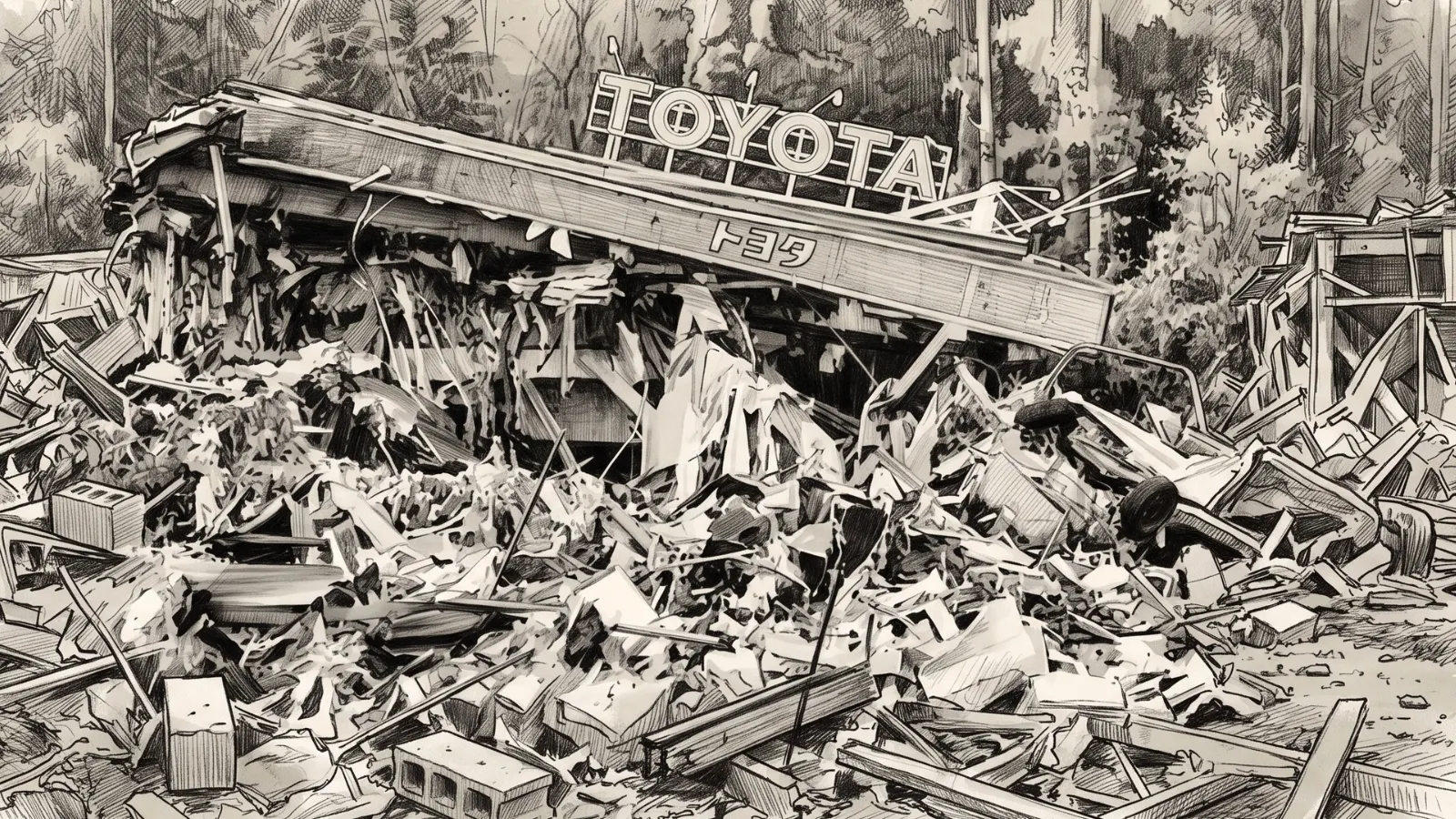
On March 11, 2011, a magnitude 9.0 earthquake struck the northeast coast of Japan, followed immediately by a tsunami that swept through the Tohoku region. The disaster was the most powerful natural disaster in Japan's modern history. The destruction of several nuclear reactors compounded the damage, cutting electricity across the region. A large area was evacuated, making rapid reopening of affected industries impossible.
78 Percent
Toyota produced 45 percent of its vehicles in Japan at the time, almost twice as much as Honda and Nissan. When the earthquake hit, the exposure was immediate and total. Plants closed. Suppliers went dark. The parts stopped moving.
Global output declined 78 percent in April 2011 compared to the same month the previous year. Some tier-1 and tier-2 suppliers were wiped out entirely, halting the production of critical microcontrollers and other essential components. With almost no stock on hand, assembly lines went dark. Net income for the quarter fell 77 percent. The disaster affected the production of over 150,000 vehicles. It took three months to recover to pre-earthquake production levels.
Toyota's Executive VP Shinichi Sasaki did not search for euphemisms. He called it a big shock to Toyota's just-in-time system.
The financial damage was severe. The strategic damage was worse. Toyota had spent years positioning itself as the most disciplined, most reliable manufacturer in the world. The earthquake did not just disrupt production. It revealed that the entire system was built on an assumption nobody had thought to question: that the world would stay still.
The Factory Nobody Knew About
Just-In-Time was not a bad idea. It was a brilliant idea that worked exactly as designed, right up until the moment the design met reality.
The logic is seductive. Inventory is waste. Time your deliveries precisely, and you do not need to hold stock. Save on storage, reduce the risk of obsolescence, keep your operation lean. For three decades, this logic held. Toyota refined it. The rest of the industry copied it. The average manufacturing firm at the time of the earthquake held just over three weeks' worth of materials inventory. Because this is an average across all inputs, there were likely many individual parts with much shorter supplies.
Three weeks sounds reasonable. It is not when the parts stop coming entirely.
But the inventory problem was only part of the story. The deeper problem was that Toyota did not actually know what its supply chain looked like. It knew its direct suppliers well. What it did not know was what existed behind those suppliers. The tier-2 and tier-3 vendors. The small factories in the Tohoku region produce a single component on which everything else in the chain depends. Renesas Electronics was one of the major global vehicle chip makers, producing as much as 40 percent of the world's automotive microcontroller supply. When its plant went down, it was not expected to return to even partial capacity for months. Renesas was not a name that appeared in Toyota's strategic planning documents. But when its plant went down, Toyota's assembly lines followed.
This is the nature of modern supply chains. The risk is rarely where you are looking. It lives in the layers you cannot see. Toyota had one of the most sophisticated manufacturing operations in the world, yet it had no idea that a single semiconductor factory in Tohoku was the linchpin holding it all together. It found out the way most companies find out. When it was too late.
What Getting Serious Actually Looks Like
Toyota did not respond to the earthquake by patching the holes and moving on. It responded by rebuilding the system from a different set of assumptions.
Before 2011, Toyota's line of sight effectively ended at its tier-1 suppliers. That was no longer acceptable. Toyota built a database covering suppliers across multiple tiers, linking parts to exact factory locations. The process of identifying which parts were at risk in a crisis took two weeks in 2011. By 2021, it was cut to half a day. Toyota formalized this through a system called RESCUE, which stores supply chain information for around 6,800 items. The goal was not just to recover faster when something went wrong. It was to know, before a disaster arrived, exactly which nodes in the network were exposed and what the alternatives were.
On inventory, Toyota made a deliberate choice to accept inefficiency in exchange for resilience. Around 500 priority parts most likely to cause production paralysis were identified, and suppliers were mandated to maintain a stock of two to six months for each. Semiconductors received special focus, with Toyota securing one to four months of chip inventory as part of its business continuity plan. Holding six months of semiconductor inventory is not lean. It is expensive. Toyota did it anyway because the cost of holding inventory is fixed, while the cost of a production shutdown is not.
The change that received the least attention and mattered the most was what happened to Toyota's supplier relationships. Toyota began sharing three-year production forecasts with suppliers to help them plan capacity. During crises, purchasing teams maintained constant communication, connecting with some suppliers ten times a day during the 2020 to 2021 semiconductor crunch. It provided financial and technical assistance to help smaller suppliers build their own contingency plans. The supplier was no longer a vendor that the purchasing team called when something went wrong. It was a partner whose stability Toyota had a direct interest in protecting, because Toyota had finally understood something it should have known all along: a supply chain is only as strong as its least visible node.
Still Running
The real test of these reforms did not come from another earthquake. It came from the global semiconductor shortage that hit the automotive industry starting in 2020.
The shortage was brutal. Plants closed. Production targets were slashed. Companies that had spent years squeezing cost out of their supply chains found themselves without the components they needed to build cars. General Motors idled plants. Volkswagen cut output. The losses across the industry ran into the billions.
Toyota kept running.
During the semiconductor shortage, Toyota's one to four-month chip inventory kept its lines running while rivals shut down their plants. The supplier database, the forecasting relationships, and the business continuity planning built after 2011 gave Toyota a different set of options than anyone else in the industry had. When Toyota's CFO Kenta Kon was asked directly whether the company foresaw any major impact from the shortage, his answer was no. The lessons learned following the 2011 earthquake, he said, had contributed to Toyota's ability to mitigate the impact of semiconductor supply disruption.
The buffers eventually ran dry. By August 2021, Toyota cut production by 40 percent. But it had bought months of uninterrupted output that its competitors had not. Those months were not an abstraction. They were units sold, customers retained, and market share gained while everyone else was trying to figure out what went wrong.
The Same Mistake, Still Being Made
The Federal Reserve's analysis of the Tohoku earthquake found that the disaster shaved nearly half a percentage point from U.S. second-quarter GDP in 2011. U.S. manufacturing output fell by about one percent in April and remained significantly below prior levels for roughly six months. One earthquake in Japan. Six months of depressed manufacturing output in the United States. The connections inside a modern supply chain are that tight, and the consequences of a single failure travel that far.
Toyota's mistake in 2011 was not that it built an efficient system. It was built on the assumption that the environment that made efficiency possible would never change. That assumption lived invisibly inside every decision Toyota made for thirty years. Nobody questioned it because it had never been wrong. Until it was.
Most companies operating today are making the same assumption. Not about earthquakes. About whatever their version of stability happens to be. A supplier relationship that has worked for a decade. A shipping route that has always been reliable. A cost structure built on conditions that existed last year. The disruptions hitting global supply chains right now, tariffs, rerouted ships, labor shortages, and demand swings, are not asking companies to do something different in kind from what Toyota faced in 2011. They are asking the same question Toyota had to answer: how much of what you think you know about your supply chain is actually true, and what happens to your business when the part you did not know about stops working?
Hannah Testani built Intelligent Audit around exactly that question. Most companies, she argues, are sitting on the data that would answer it. The shipping records exist. The carrier data exists. The cost structures are documented somewhere. What is usually missing is the visibility to see it all in one place and the willingness to act on what it shows. Toyota built that visibility after the earthquake because it had no choice. The companies that build it now, before the next disruption, rather than because of it, are the ones that will still be running when everyone else is trying to understand what they missed.