
The great workforce paradox: How forward-thinking CEOs are rebuilding human capital strategy in an AI-driven labor market contraction
How visionary leaders are navigating the unprecedented challenge of simultaneously cutting costs through automation while building the skilled workforce needed for future growth.
 CEO.com
11 min read
CEO.com
11 min read

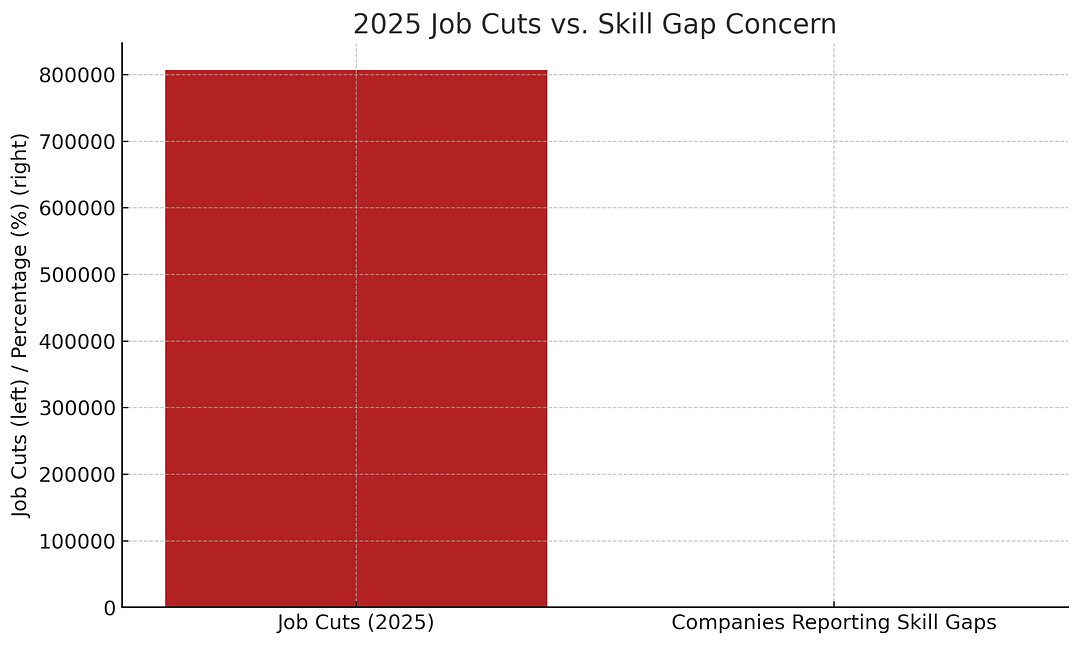
In the summer of 2025, as American employers announced 806,383 job cuts—a 75% increase from 2024 — Fortune 500 CEOs confronted an unprecedented paradox: How do you cut headcount to meet efficiency goals while also tackling the biggest skills shortage in modern business history?
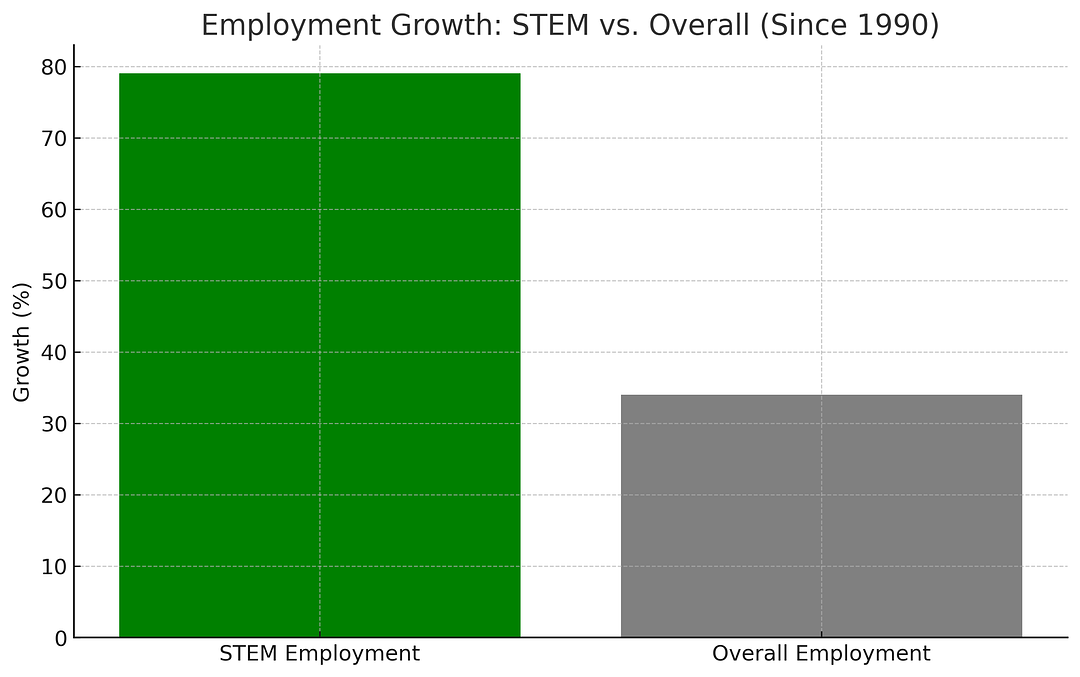
The numbers tell a compelling story of contradiction. Technology companies alone cut 89,251 positions in 2025, a 36% increase from 2024, while 87% of companies globally report current or expected skill gaps. Meanwhile, STEM employment has grown 79% since 1990 compared to just 34% overall employment growth — yet the skills gap could result in $8.5 trillion in unrealized annual revenues by 2030.
This workforce paradox represents more than statistical curiosity — it's reshaping how the world's most successful CEOs think about human capital strategy in an era of accelerating technological change.
The Anatomy of the Workforce Paradox
The current labor market disruption differs fundamentally from previous economic cycles. Unlike recession-driven layoffs that broadly reduce headcount, today's workforce transformation is surgical — AI and automation account for over 10,000 job cuts monthly, targeting specific functions while creating unprecedented demand for complementary skills.
Consider the technology sector's evolution: while major companies like Intel plan to cut 24,000 jobs through 2025, STEM job postings outnumbered unemployed STEM workers by 13 to 1 as recently as 2016. The disconnect shows not a labor surplus but a massive skills mismatch.
The Leadership Challenge: How do CEOs sustain operational efficiency while developing organizational capabilities for an uncertain future?
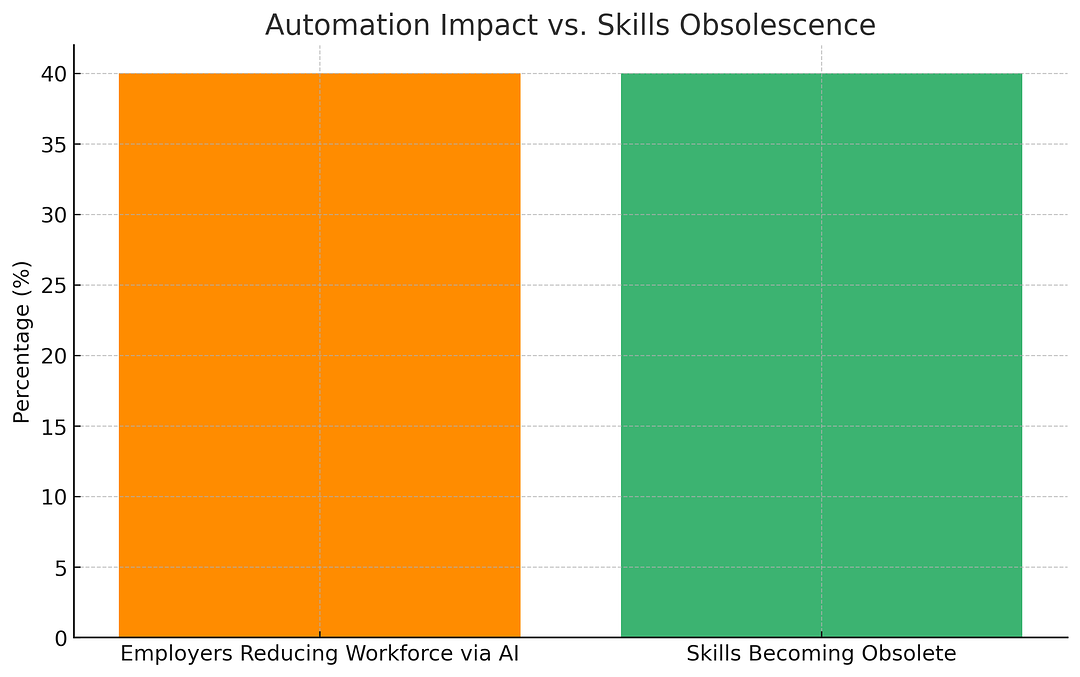
The Strategic Reality: 40% of the skills people rely on at work today will be outdated within the next few years, yet only 42% of employees feel their company offers adequate upskilling opportunities.
The Automation Acceleration
The current wave of workforce disruption is driven by what labor economists term "complementary displacement" — AI systems that enhance human capability in some areas while completely replacing it in others. Research indicates that 40% of employers expect to reduce their workforce where AI can automate tasks, while simultaneously creating demand for roles that require AI literacy and strategic oversight.
The most sophisticated CEOs understand this isn't simply about replacing workers with machines. Companies like Intuit laid off 1,800 employees while simultaneously investing savings in AI technology, demonstrating how workforce transformation requires strategic reallocation rather than simple reduction.
The Skills Scarcity Crisis
Parallel to automation-driven displacement runs a deepening skills shortage that predates AI advancement. STEM jobs are projected to grow 10.4% between 2023 and 2033 — almost three times faster than non-STEM occupations — while the U.S. faces a shortage of 3.5 million skilled workers by 2025.
The challenge extends beyond technical skills. Research from multiple business schools indicates that 38% of an organization's workforce requires fundamental retraining or replacement within three years to address evolving business needs.
Strategic Frameworks: Learning from the Leaders
CEO.com Strategic Framework: Navigating Human Capital Decisions in the AI Era
Framework 1: The Human Capital Value Matrix
The most successful CEOs have moved beyond binary "automate or retain" decisions to a more sophisticated approach of workforce categorization based on automation potential and human capital value. This strategy, pioneered by companies facing severe skills shortages while managing cost pressures, creates four distinct strategic quadrants.
Automate Quadrant (High Automation, Low Human Capital Value):
Companies are strategically replacing routine functions while redirecting human resources to higher-value activities. IBM's commitment to replace nearly 8,000 jobs with AI over five years exemplifies this approach, focusing automation on repetitive tasks while investing in strategic human capabilities.
Augment Quadrant (High Automation, High Human Capital Value):
This represents the workforce transformation sweet spot—combining AI efficiency with human expertise. Companies report 25-40% productivity gains when successfully implementing AI-human collaboration in complex problem-solving roles.
Develop Quadrant (Low Automation, High Human Capital Value):
These roles — strategic planning, innovation leadership, complex relationship management — require intensive investment in human capability development. Forward-thinking CEOs allocate up to 40% of workforce investment in this category.
Protect Quadrant (Low Automation, Medium Human Capital Value):
Skilled trades, creative roles, and relationship-intensive positions that remain largely immune to automation but require optimization and maintenance rather than transformation.
Framework 2: Skills-Based Talent Architecture
Leading CEOs have abandoned traditional job-description-based hiring for skills-focused talent strategy. This approach enables organizations to recruit based on potential and provide tailored training to develop top-tier employees rather than limiting themselves to candidates with existing qualifications.
Implementation Strategy:
- Skills Ontology Development: Using AI to map existing skills and identify evolving needs, ensuring ongoing relevance as business requirements change
- Dynamic Learning Pathways: Creating individualized development programs that bridge skills gaps while maintaining operational effectiveness
- Internal Mobility Optimization: Cross-training programs that build multi-functional capabilities while reducing external hiring dependency
The CEO.com Human Capital Playbook
Strategic Principle 1: Talent Density Over Headcount
The most effective CEOs have shifted focus from workforce size to talent density — maximizing the impact and adaptability of each team member. This approach emphasizes hiring autonomous, values-aligned team members who can operate with minimal oversight while contributing to collective problem-solving capability.
Practical Implementation:
- Role Clarity: Ensuring team members understand how their positions contribute to broader organizational goals
- Coaching Enhancement: Moving beyond task management to development-focused leadership
- Strategic Recruitment: Prioritizing cultural fit and learning agility over specific technical qualifications
Strategic Principle 2: Predictive Workforce Planning
Rather than reacting to skills shortages, leading CEOs employ AI-driven scenario planning to anticipate future talent needs. This approach enables proactive development programs that prepare current employees for evolving roles rather than replacing them with external hires.
Advanced Analytics Application:
Skills inference technology analyzes employee data to quantify skills proficiency, providing detailed insight into workforce capabilities that can be broken down by business unit and geography. This precision enables targeted development investments that deliver measurable ROI.
Strategic Principle 3: Integrated Learning Ecosystem
The most successful workforce transformations integrate internal development with external partnerships. Companies are building relationships with universities to create sustainable talent pipelines while simultaneously developing internal certification programs that incentivize skill acquisition.
Partnership Strategy:
- University Collaborations: Establishing direct relationships with educational institutions to influence curriculum development
- Internal Academies: Creating company-specific learning programs that combine technical skills with organizational culture
- Industry Consortiums: Participating in sector-wide initiatives to address common skills challenges
Ethical Leadership During Downsizing
The workforce paradox presents unique ethical challenges for CEOs who must balance efficiency needs with responsibilities for human development. Research indicates that companies that increase upskilling efforts during uncertain periods demonstrate superior crisis response capabilities.
Best Practices from Leading CEOs:
- Transparent Communication: Providing clear frameworks for understanding workforce changes and development opportunities
- Redeployment Over Replacement: Focusing on retraining employees for AI-augmented roles rather than wholesale staff replacement
- Investment in Growth: Demonstrating commitment to employee development even during cost reduction periods
Building Organizational Resilience
Research from LinkedIn's Economic Graph team shows that in labor market downturns, women hired into leadership positions decreases significantly, highlighting how workforce contractions can undermine diversity and inclusion efforts. Leading CEOs proactively address these challenges through strategic talent development programs.
Resilience Strategy:
- Diverse Pipeline Development: Ensuring skills development programs maintain or improve workforce diversity
- Succession Planning: Building internal leadership capabilities that reduce dependency on external executive recruitment
- Knowledge Transfer Systems: Capturing institutional knowledge from departing employees while building capabilities in remaining staff
New Metrics for New Challenges
Traditional HR metrics fall short in measuring success during simultaneous workforce reductions and skills development. Leading CEOs use advanced measurement frameworks that track both efficiency improvements and capability growth.
Quantitative Indicators:
- Skills Development ROI: Companies report 300%+ returns on targeted upskilling investments
- Internal Mobility Rates: Percentage of positions filled through internal development versus external hiring
- Productivity Per Employee: Measuring output increases that justify workforce investment during headcount reduction
- Innovation Index: Tracking new product development and process improvements as indicators of enhanced human capital
Qualitative Assessments:
- Employee Readiness: Regular skills assessments that identify development needs before they become critical gaps
- Organizational Agility: Speed of adaptation to new technology and market requirements
- Leadership Pipeline Strength: Depth of internal candidates prepared for senior roles
The Competitive Advantage of Human Capital Excellence
Creating Sustainable Differentiation
In an environment where technology adoption levels the playing field across competitors, human capital strategy becomes the primary source of sustainable competitive advantage. CEOs who successfully navigate the workforce paradox emerge with organizations capable of rapid adaptation and continuous innovation.
Strategic Outcomes:
- Reduced Recruitment Costs: Internal talent development programs cost significantly less than external executive searches
- Accelerated Innovation Cycles: Teams with diverse, developed skill sets demonstrate superior problem-solving capability
- Enhanced Market Responsiveness: Organizations with adaptive workforces can pivot strategies more quickly than competitors
Future-Proofing Organizational Capability
The best CEOs recognize that workforce transformation is not a temporary crisis management exercise but a fundamental shift in how organizations build and maintain competitive capability. Nearly 40% of current workplace skills will be outdated soon, requiring continuous adaptation rather than periodic adjustment.
Long-Term Strategy Elements:
- Continuous Learning Culture: Embedding skills development into daily operations rather than treating it as a separate HR function
- Technology-Human Integration: Developing organizational capabilities that leverage AI to enhance rather than replace human judgment
- Adaptive Leadership Development: Preparing managers to lead hybrid human-AI teams effectively
The New Leadership Imperative
The workforce paradox calls for CEO leadership that balances seemingly conflicting needs: cutting costs while investing more in human development, automating routine tasks while fostering creativity, managing current performance while preparing for future unknowns.
Critical Success Factors:
- Establish workforce transformation as a CEO-led strategic initiative rather than delegating to HR departments
- Balance short-term efficiency gains with long-term capability development investments
- Maintain transparent stakeholder communication during periods of workforce uncertainty
- Invest in predictive technologies that enable proactive rather than reactive talent management
Risk Management in Human Capital
The traditional approach to workforce risk management — maintaining adequate staffing levels and succession plans — proves insufficient in an environment of rapid skills obsolescence. Companies face potential losses of $8.5 trillion globally due to talent shortages, making human capital risk management a board-level strategic priority.
Advanced Risk Mitigation:
- Skills Portfolio Management: Diversifying organizational capabilities to reduce dependency on specific technical skills
- Partnership Networks: Building relationships with educational institutions and training providers to ensure access to emerging talent
- Scenario Planning: Developing workforce strategies that remain effective across multiple technological and economic scenarios
The Path Forward: Mastering the Paradox
As the workforce paradox continues to reshape global business, the CEOs who emerge strongest will be those who master the art of strategic contradiction — simultaneously cutting costs and investing in capabilities, automating routine work while developing human creativity, reducing headcount while expanding organizational capacity.
The evidence from 2025's unprecedented workforce transformation reveals that this paradox is not a temporary challenge to endure but a permanent feature of modern business leadership. With 87% of companies facing skills gaps and AI creating both displacement and opportunity, the workforce paradox will define CEO effectiveness for the next decade.
The most successful leaders have already started building organizations that thrive on this tension — creating workforces that are simultaneously more efficient and more capable, smaller and more powerful, automated and more human. They recognize that in an era of rapid change, the companies that succeed will be those that can transform their human capital as quickly as they adopt new technologies.
For CEOs facing similar challenges, the workforce paradox provides a vital insight: sustainable competitive advantage in the AI era doesn't come from choosing between human talent and technology but from skillfully blending both into organizational systems that are more adaptable, innovative, and resilient than either could be alone.
The question for business leaders is not whether the workforce paradox will persist — it will. The real question is whether they can create organizations that turn this core contradiction into their biggest competitive advantage.
About This Case Study
"The Great Workforce Paradox: How Forward-Thinking CEOs are Rebuilding Human Capital Strategy in an AI-Driven Labor Market Contraction" was created as part of CEO.com’s ongoing commitment to provide enterprise leaders with rigorous, actionable research for navigating unprecedented workforce transformation. This case study addresses the pressing challenges Fortune 500 CEOs encounter, as mass layoffs and record technology-driven productivity gains intersect with the most significant skills shortage of the modern era.
Drawing on current data from federal labor statistics, STEM employment reports, global HR surveys, economic impact studies, and verified company announcements, the analysis combines quantitative and qualitative insights from reputable sources including the National Science Foundation, Bureau of Labor Statistics, World Economic Forum, Korn Ferry, and peer-reviewed HR research. Additional perspectives were obtained from CEO interviews, business media coverage, and leading academic reports to reflect the real-time strategies and challenges facing executive decision makers in 2025.
The study uses the Harvard Business School case method customized for CEO.com’s executive audience — analyzing the situational context, strategic actions by top companies, and outcome metrics to identify frameworks CEOs can implement immediately. All key facts, statistics, and frameworks are linked to their sources, enabling verification and further investigation.
No proprietary or confidential data was used; all findings are based on publicly accessible and independently validated sources. The resulting case study is designed to arm CEOs and C-level executives with the context, benchmarks, and strategic models needed to thrive — and lead ethically — amid ongoing labor market disruption and technological upheaval.
About CEO.com
CEO.com is the premier leadership platform, dedicated to providing today’s top CEOs and leaders with essential resources, insights, and relationships to create powerful outcomes.
By curating exclusive communities, a thought-provoking podcast and magazine, and enduring experiences — including the League of CEOs, Executive Circles, Regional Leadership Councils, and the CEO.com Awards — we foster strong relationships and create valuable growth opportunities.
- https://techcrunch.com/2025/07/31/tech-layoffs-2025-list/
- http://www.challengergray.com/blog/summer-lull-ends-july-job-cuts-spike-tech-ai-tariffs-blamed/
- https://layoffs.fyi
- https://finance.yahoo.com/news/comprehensive-list-2025-tech-layoffs-134836336.html
- https://www.reddit.com/r/jobsearch/comments/1kwfnaz/over_75000_people_impacted_by_tech_layoffs_in/
- https://labs.sogeti.com/the-ethical-implications-of-ai-and-job-displacement/
- https://www.i4cp.com/press-releases/2025-top-hr-priorities-predictions
- https://intellizence.com/insights/layoff-downsizing/major-companies-that-announced-mass-layoffs/
- https://www.weforum.org/stories/2025/04/ai-jobs-international-workers-day/
- https://hrexecutive.com/what-are-ceos-top-concerns-for-2025/
- https://www.geekwire.com/2025/microsoft-cuts-another-40-jobs-in-washington-state-continuing-layoffs-amid-ai-investment-surge/
- https://www.innopharmaeducation.com/blog/the-impact-of-ai-on-job-roles-workforce-and-employment-what-you-need-to-know
- https://blog.workday.com/en-us/hr-trends-to-watch-in-2025-building-the-human-centric-workplace.html
- https://www.seattletimes.com/business/is-ai-causing-tech-worker-layoffs-as-ceos-claim-reality-is-complicated/
- https://www.forbes.com/sites/jackkelly/2025/04/25/the-jobs-that-will-fall-first-as-ai-takes-over-the-workplace/
- https://www.lifelabslearning.com/blog/priorities-ceos-and-hr-leaders-can-agree-on-in-2025
- https://www.cbsnews.com/news/ai-jobs-layoffs-us-2025/
- https://camoinassociates.com/resources/how-ai-is-impacting-the-us-workforce/
- https://www.aihr.com/blog/human-resource-strategy/
- https://www.nexford.edu/insights/how-will-ai-affect-jobs
- https://ncses.nsf.gov/pubs/nsb20245/u-s-stem-workforce-size-growth-and-employment
- https://www.bls.gov/opub/btn/volume-14/stem-alternate-definitions.htm
- https://www.americanimmigrationcouncil.org/report/sizing-up-the-gap-in-our-supply-of-stem-workers/
- https://www.codewizardshq.com/stem-statistics/
- https://cadrek12.org/announcements/new-report-stem-good-jobs-now-and-future
- https://www.hrdconnect.com/2024/03/05/bridging-the-skills-gap-the-role-of-upskilling-and-reskilling-in-modern-business/
- https://www.tmi.org/blogs/how-to-build-a-strong-talent-pipeline-for-future-leadership
- https://journalistsresource.org/economics/stem-good-jobs-future-science/
- https://www.visualworkforce.com/blog/why-the-skills-gap-is-still-growing
- https://www.phenom.com/blog/talent-pipeline-strategy
- https://www.bls.gov/opub/btn/volume-10/why-computer-occupations-are-behind-strong-stem-employment-growth.htm
- https://cisr.mit.edu/publication/2024_0401_DigitalTalentTransformation_VanderMeulenTonaLeidner
- https://unitiq.com/blog/tpost/ovu5mnntp1-invest-in-talent-acquisition-and-make-it
- https://www.pewresearch.org/social-trends/2021/04/01/stem-jobs-see-uneven-progress-in-increasing-gender-racial-and-ethnic-diversity/
- https://lightcast.io/skills-driven-workforce-transformation
- https://www.compunnel.com/blogs/building-a-future-ready-talent-pipeline-strategic-approaches-for-hiring-success/
- https://www.issues.org/stem-workforce-shortage-data-hira/
- https://www.kornferry.com/insights/featured-topics/future-of-work/future-proof-your-organization-with-the-workforce-skills-needed
- https://www.instride.com/insights/talent-pipeline/
- https://ncses.nsf.gov/pubs/nsb20212/stem-labor-market-conditions-and-the-economy