
What Sam Altman could learn from a 1974 biology lab
Responsibility isn't something you claim after the fact. It's something you carry before.
 CEO.com
7 min read
CEO.com
7 min read
In the summer of 1974, a small group of scientists did something that would be almost unthinkable today. They stopped.
Paul Berg at Stanford had just figured out how to cut DNA from one organism and splice it into another. It was the kind of breakthrough that careers are made of, the kind of discovery that wins Nobel Prizes. And it did, eventually. But before Berg pursued the glory, before he published, before he scaled his work into something commercially valuable, he paused.
He paused because he understood something that too few leaders understand today: the weight of what he was holding.
Berg and his colleagues, Stanley Cohen and Herbert Boyer among them, called for a voluntary global moratorium on their own work. Not because anyone made them. Not because there was a scandal. Not because regulators were breathing down their necks. There were no regulators. There was no framework. There was nothing but their own conscience and their own capacity to imagine what they had unleashed.
They stopped because they understood the implications before anyone else did.
"We could not proceed," Berg later said, "without first assessing the potential dangers."
I've been thinking about this story for months now. I keep coming back to it because it represents something we've almost entirely lost in our modern conception of leadership: the idea that responsibility isn't something you claim after the fact. It's something you carry before.
The scientists at Asilomar didn't wait for public outcry. They didn't wait for congressional hearings, class-action lawsuits, or a PR crisis to force their hand. They looked at what they had created, they imagined what it could become, and they chose to stop. They accepted lost time, lost prestige, lost money. They made the process public. They invited critics, ethicists, journalists, and government observers to a conference to establish binding safety standards for their own work.
And then, only then, did they resume.
This is what responsibility looks like when leaders actually mean it.
I bring this up because we are living through another Asilomar moment, except this time the scientists aren't stopping.
A handful of people, and we can count them on our fingers, are building technology that will reshape every aspect of human existence. The economy. Democracy. The nature of work. The meaning of knowledge. The structure of power itself. This isn't hyperbole. The people building these systems say as much themselves.
Sam Altman has said that "entire classes of jobs will go away," that customer service roles will be "totally, totally gone." Dario Amodei has warned that half of all entry-level white-collar jobs could be eliminated within five years, that unemployment could spike to 20 percent. These aren't fringe predictions from doomsayers. These are the CEOs of the two most important AI companies on Earth, telling us what their own creations will do.
But here's what separates them: one of these men seems to actually feel the weight of what he's saying.
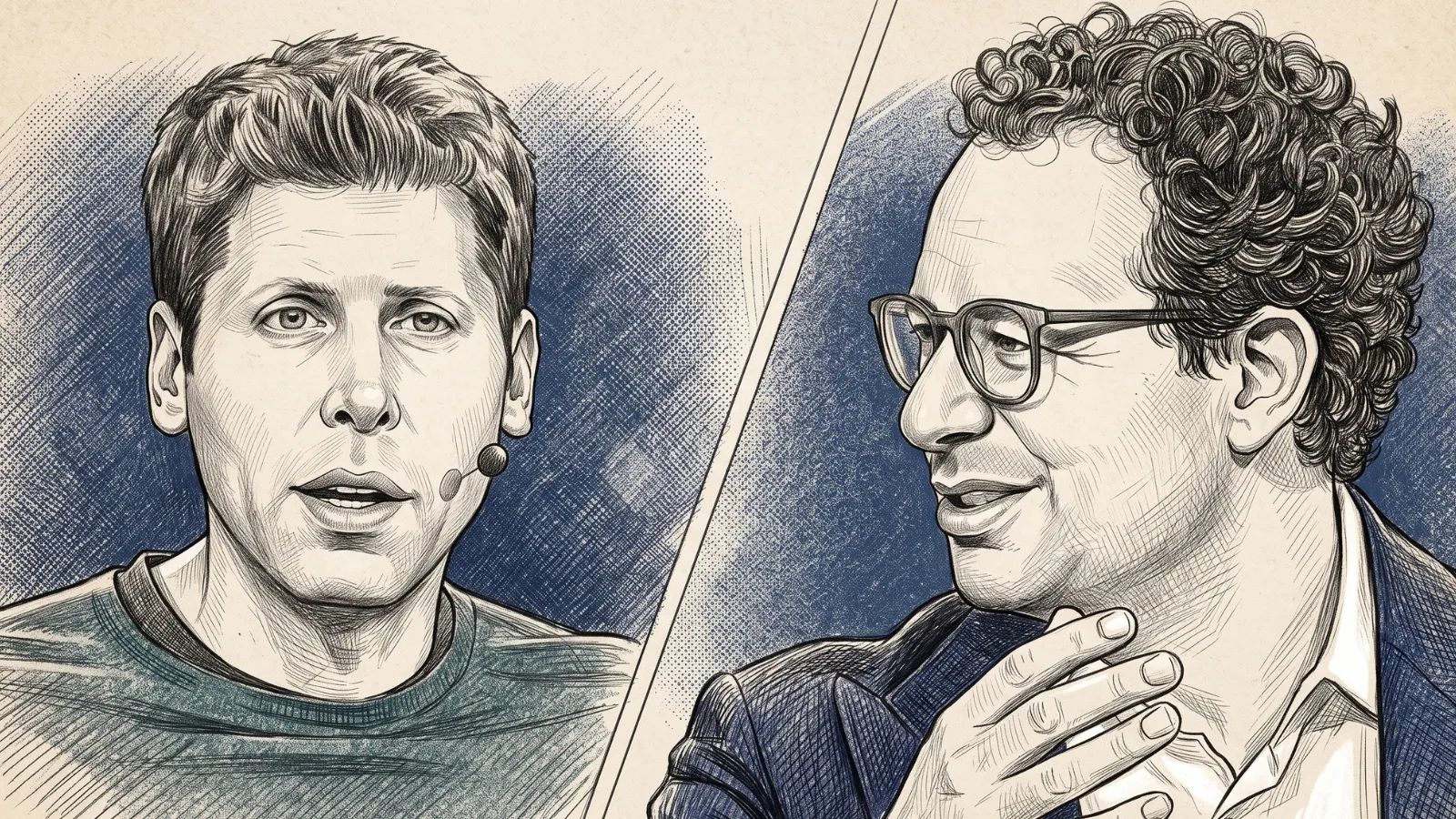
The contrast between Sam Altman and Dario Amodei is the contrast between claiming responsibility and carrying it.
When Altman testified before Congress in 2023, he called for the creation of a federal licensing agency to regulate AI. "Government intervention will be critical," he said. It was the right thing to say. It made headlines. It positioned him as a thoughtful leader willing to accept constraints on his own industry.
Two years later, Altman returned to Congress with a different message. Requiring government approval to release AI software, he now warned, would be "disastrous." The word "safety," which had appeared dozens of times in his 2023 testimony, was largely absent. The man who had called for regulation was now warning against it.
What changed? OpenAI had grown into a $300 billion company. The nonprofit mission to benefit humanity had quietly transformed into a capped-profit structure, and then into plans for a full conversion to for-profit status. The safety team that had been promised 20 percent of the company's computing resources was starved of those resources until its leaders quit. The co-founder and chief scientist who helped build GPT-3 had left. Twenty-five senior researchers had walked out the door.
"Over the past years," Jan Leike wrote when he resigned, "safety culture and processes have taken a backseat to shiny products."
Meanwhile, when departing employees tried to speak publicly about their concerns, they discovered that OpenAI's exit paperwork included provisions that would strip them of their vested equity if they ever criticized the company. Lifetime gag orders, enforced by the threat of financial ruin. When this became public, Altman said he was "genuinely embarrassed" and claimed he didn't know about the policy.
But journalists obtained documents bearing his signature that explicitly authorized those provisions.
This is what claiming responsibility looks like. You say the words. You make the gesture. And then you do whatever you were going to do anyway.
Dario Amodei represents something different.
When Amodei was at OpenAI, he saw what the company was becoming. He watched the Microsoft billions flow in. He watched safety concerns get pushed aside in favor of commercial expansion. And rather than stay and fight a losing battle, he left. He took the people he trusted and went to build something else.
"It is incredibly unproductive to try and argue with someone else's vision," Amodei has said. "Take some people you trust and go make your vision happen."
What he built at Anthropic isn't perfect. No company is. But the differences are striking.
Where OpenAI dissolved its safety team, Amodei spends 10 to 20 percent of his time as CEO personally working on safety policy. He wrote multiple drafts of Anthropic's Responsible Scaling Policy himself. His co-founder devoted half of their time to developing safety frameworks. The signal this sends to employees is unmistakable: the people at the top actually care about this.
Where Altman's position on regulation has shifted with the commercial winds, Amodei has been consistent. When Anderson Cooper asked him, "Who elected you and Sam Altman?" to make decisions about humanity's future, Amodei didn't get defensive. He said he was "deeply uncomfortable" with these decisions being made by a few companies and a few people. He said this is exactly why he has "always advocated for responsible and thoughtful regulation."
Always. Not when it was convenient. Not when it made for good PR. Always.
While Altman has offered vague promises that AI will create "entirely new classes of jobs" to replace the ones it destroys, Amodei has proposed something concrete: a "token tax" requiring AI companies to contribute 3 percent of their revenues to fund worker retraining programs and social safety nets. This is not in his economic interest, as he readily admits. But he proposed it anyway, because he understands that the companies creating the disruption bear some obligation to address it.
"If AI creates huge total wealth," Amodei has said, "a lot of that will, by default, go to the AI companies and less to ordinary people."
He is describing his own company. He is describing wealth that would flow to him. And he is proposing to tax it.
This is what carrying responsibility looks like. You don't just say the words. You accept the cost.
The most telling contrast might be what these two men say about their own role.
When critics question OpenAI's direction, Altman tends to be defensive. He has grown frustrated with skeptics and has offered to help anyone who doubts OpenAI's business model sell their shares. He has suggested that critics should "put their money where their mouths are" by shorting the company's stock. This is the language of a man who sees himself as running a business, who measures his critics by whether they're willing to bet against him financially.
When critics question Anthropic's direction, Amodei tends toward humility. "You could end up in the world of the cigarette companies or the opioid companies," he has said, "where they knew there were dangers and they didn't talk about them and certainly did not prevent them."
He is warning himself. He is naming the trap he is trying to avoid.
This is not to say that Amodei is a saint. He runs a company valued at $183 billion. He is building the same world-changing technology as his competitors. He has accepted investments from sources he himself acknowledges are problematic. He is not above the race; he is in it.
But there is a difference between a man who wrestles with the weight of what he's building and a man who has convinced himself the weight doesn't exist. There is a difference between a leader who says "I'm worried about this" and then proposes concrete solutions at cost to himself, and a leader who says "I take full responsibility" and then changes nothing.
One of these men sounds like Paul Berg.
The other does not.
Here's what I keep coming back to: the scientists at Asilomar could have told themselves a hundred different stories to justify continuing. They were in a race. Others would do it if they didn't. The benefits outweighed the risks. Progress couldn't be stopped. All the same stories that AI leaders tell themselves today.
But Berg and his colleagues understood something that seems to have been lost: you don't get to outsource moral responsibility to the system. You don't get to say, "Well, if we don't do it, someone else will" and then wash your hands of the consequences. That's not leadership. That's cowardice dressed up in inevitability.
The question isn't whether AI will be developed. It will. The question is whether the people developing it will bear the weight of what they're building or tell themselves it's someone else's problem.
Paul Berg didn't wait for someone else to assess the dangers of his work. He did it himself, at cost to himself, because he understood that the people with the most power have the most responsibility.
That's not a complicated principle. A child could understand it.
The Asilomar moratorium lasted about a year. When it ended, the scientists resumed their work under strict conditions they had designed themselves. The field of genetic engineering flourished. The technology advanced. And it did so within a framework of safety that the scientists themselves had built, because they understood that their power came with proportional obligation.
Recombinant DNA went on to transform medicine, agriculture, and our understanding of life itself. But it did so without the catastrophic accidents that Berg and his colleagues had feared. Not because regulators saved us. Because the people with the most knowledge and the most power chose to act like adults.
That's the choice facing AI leaders today.
You can tell yourself that the race is too urgent. You can tell yourself that someone else would do it anyway. You can tell yourself that the benefits outweigh the risks, that progress can't be stopped, that responsibility is someone else's problem.
Or you can do what Paul Berg did.
You can pause. You can assess. You can design the guardrails yourself. You can accept the cost.
You can carry the weight.
The scientists at Asilomar showed us what's possible when leaders take responsibility proportional to their power. They showed us that pausing is realistic, that self-imposed constraints are possible, that you don't need a scandal or a regulator or a catastrophe to do the right thing.
You just need to understand the weight of what you're holding.
And you need to be willing to carry it.