
When the Pentagon comes knocking
When the government asks you to remove the guardrails, what do you do?
 CEO.com
8 min read
CEO.com
8 min read
On the evening of February 27, as the United States and Israel were preparing to launch airstrikes on Iran, President Trump took to Truth Social to order the federal government to stop using the AI technology of one of America's most prominent artificial intelligence companies.
Defense Secretary Pete Hegseth followed within hours, designating Anthropic, the maker of the Claude AI model, a "supply chain risk to national security." It was a label previously reserved for foreign adversaries like China's Huawei. It had never before been applied to an American company.
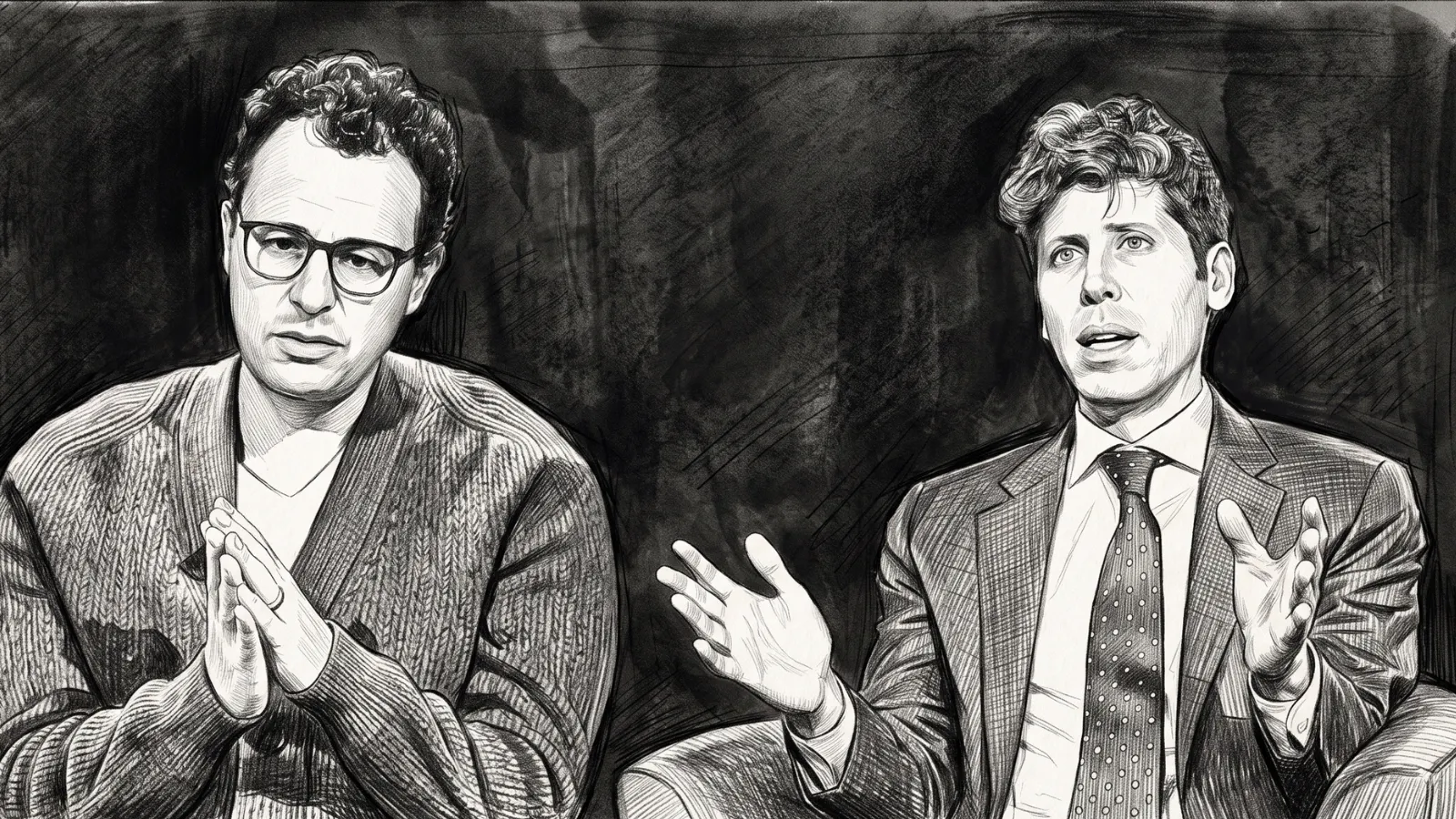
Within the same news cycle, OpenAI CEO Sam Altman announced that his company had reached a deal with the Pentagon.
The episode that produced those two events is the most consequential confrontation yet between the AI industry and the federal government. It has drawn in federal courts, members of Congress, and nearly every major AI company. It has also forced a reckoning that defense tech CEOs have long known was coming: When the government asks you to remove the guardrails on your technology, what do you do?
Andrew Powell has thought about that question carefully. Powell is the co-founder and CEO of Ethos, which builds AI-powered readiness platforms for the U.S. Department of Defense, training military personnel across Air Force, Navy, and Army installations on the knowledge and skills they need to perform high-stakes missions. Ethos is embedded in the classified networks of the U.S. military. Its customers are war fighters. Powell knows this world from the inside.
In a recent interview with CEO.com, he laid out his view before the Anthropic dispute reached its peak. It is a view worth understanding because it represents a serious answer to the question now consuming the industry.
"Our government leaders are the ones who should be entrusted with deciding the law, not unelected tech companies," Powell said. He is skeptical that private technology companies should position themselves as the primary check on how the government uses the tools it purchases. That is the job of elected officials, courts, and the democratic system. At the same time, he expressed something that went beyond legal philosophy. "I would hope that we all think about the consequences of our actions here and try to steer things towards the world that we want to live in in the future."
Both of those ideas, the limits of corporate authority over government decisions and the obligation to think about consequences, turned out to be exactly what the Anthropic crisis was about.
How it started
The relationship between Anthropic and the Pentagon began as a success story. In July 2025, the two parties signed a $200 million contract, and Anthropic's Claude became the first frontier AI model approved for use on the DoD's classified networks. The company had earned that position through years of careful work building what it called Claude Gov models, custom-built for national security customers and deployed on infrastructure powered by Amazon Web Services.
The contract included two restrictions that Anthropic had insisted on from the beginning. Its technology could not be used for mass domestic surveillance of American citizens. It could not power fully autonomous weapons systems, defined as those capable of selecting and engaging targets without direct human oversight. The Pentagon agreed to those terms.
The trouble began in the fall of 2025, when the DoD, operating under the Trump administration's renaming of the department to the Department of War, began pushing for broader access. Defense Secretary Pete Hegseth issued a memorandum calling for all DoD AI contracts to incorporate standard "any lawful use" language within 180 days. Adding that phrase to the Anthropic contract would have effectively nullified both restrictions.
Negotiations continued and were, by most accounts, initially cordial. Anthropic offered to help the DoD transition to another vendor if an agreement could not be reached. But the talks became public in January, and once they did, the temperature rose quickly.
The ultimatum
On February 24, Hegseth gave Anthropic co-founder and CEO Dario Amodei a deadline: agree by 5:01 p.m. on Friday, February 27, to allow unrestricted use of Claude for all legal purposes, or face consequences.
Amodei did not agree. In a public statement, he explained in detail why. On autonomous weapons, he was direct: frontier AI systems are "simply not reliable enough to power fully autonomous weapons," and without proper oversight they "cannot be relied upon to exercise the critical judgment that our highly trained, professional troops exhibit every day." On surveillance, his argument was both more nuanced and, in some ways, more unsettling. Amodei told Fortune that Anthropic supports 98 to 99 percent of the military's use cases. His concern was specifically that AI has made certain forms of surveillance newly possible without those activities being newly illegal. "That actually isn't illegal. It was just never useful before the era of AI. So there's this way in which domestic mass surveillance is getting ahead of the law," he said. "The technology's advancing so fast that it's out of step with the law."
Powell had made a strikingly similar observation in the CEO.com interview, without reference to any specific dispute. "If you do have completely unfettered pursuit of technology purely for the goal of the technological advancement with no regard for what the societal or economic impact would be, then you probably are going to run afoul of people who are more focused on, well, are we building a country that I want to live in?" The concern about technology outpacing accountability is one that serious people in the defense tech world share across the ideological spectrum.
The Pentagon's response to Amodei's statement was immediate. On February 27, Trump ordered all federal agencies to cease using Anthropic's products, with a six-month phase-out period. Hegseth designated the company a supply chain risk, requiring defense contractors, including Amazon, Microsoft, and Palantir, to certify they were not using Claude in their military work. Pentagon official Emil Michael called Amodei "a liar" who "has a God-complex." Hegseth reposted both of Michael's messages.
Amodei called the threats "inherently contradictory," noting that "one labels us a security risk; the other labels Claude as essential to national security."
Powell watched all of this with frustration more than alarm. He had expressed hope in the CEO.com interview that Anthropic and the Pentagon would find a resolution. He considers Anthropic's models among the best in the world and has friends who work there. On the supply chain risk designation specifically, he did not hold back. "I thought that was kind of ridiculous to slap that on them when it's like, clearly they have been a tremendous asset so far in kind of the classified work."
The OpenAI question
The same evening Anthropic was blacklisted, Sam Altman posted on X announcing that OpenAI had reached its own deal with the Pentagon.
The timing was immediately controversial. In a post on X, Altman said his company's new defense contract included protections addressing the same issues that had become a flashpoint for Anthropic. "Two of our most important safety principles are prohibitions on domestic mass surveillance and human responsibility for the use of force, including for autonomous weapon systems," he wrote. He also said OpenAI had asked the Pentagon to offer those same terms to all AI companies, including Anthropic, and that he disagreed with the supply chain risk designation.
The reaction, both inside and outside the AI industry, was sharp. Critics accused OpenAI of opportunism. Consumers sent Claude surging past ChatGPT to the top of Apple's App Store. Chalk graffiti criticizing OpenAI appeared outside its San Francisco offices. More than 60 OpenAI employees signed an open letter supporting Anthropic's position. Over 300 Google employees sent a similar letter to their own leadership.
The picture that emerged over the following days was more complicated than simple opportunism, though the optics were genuinely bad. Altman had told employees in an internal memo the day before the announcement that OpenAI shared Anthropic's red lines on surveillance and autonomous weapons. He had privately been trying to persuade the Pentagon to find an off-ramp for Anthropic. Axios reporting on internal Slack messages showed Altman characterizing his role as trying to "save" his competitor, while simultaneously acknowledging that the optics might not look good and privately venting that Amodei had spent years trying to undermine him.
When the deal was announced, Altman said OpenAI had secured contractual protections against the same two issues that had become a flashpoint for Anthropic. He pushed the Pentagon to offer the same terms to all AI companies. He publicly stated he disagreed with the supply chain risk designation.
He also admitted he had moved too fast. "We were genuinely trying to de-escalate things and avoid a much worse outcome," he said, "but I think it just looked opportunistic and sloppy." He then amended the contract, adding more explicit language restricting domestic surveillance.
Amodei was not persuaded. In an internal memo that became public, he called Altman's messaging "straight up lies," writing that "the main reason they accepted the DoD's deal and we did not is that they cared about placating employees, and we actually cared about preventing abuses." He later apologized for the tone of the memo.
Legal experts were divided on whether OpenAI's contract actually provided meaningful protections or merely repackaged the same "any lawful use" framework that Anthropic had refused. Senator Elizabeth Warren opened an investigation into both the Anthropic designation and the OpenAI contract, writing that she was concerned the DoD appeared to be "trying to strong-arm American companies into providing the Department with the tools to spy on American citizens and deploy fully autonomous weapons without adequate safeguards."
The courts decide
Anthropic filed suit on March 9 in a California federal court, arguing the government's actions had caused irreparable harm and requesting an injunction against the supply chain risk designation.
On March 26, Judge Rita Lin granted that injunction. Her ruling ran 43 pages. The core finding was that the government had not acted out of genuine national security concern. It had punished a company for speaking publicly.
An internal DoD memo had stated that Anthropic's risk level escalated because it was engaging in an "increasingly hostile manner through the press." That memo was, in the judge's reading, dispositive. Amodei had published an essay on AI safety. The company had issued a public statement explaining its position in the contract dispute. Those are constitutionally protected acts. "Punishing Anthropic for bringing public scrutiny to the government's contracting position is classic illegal First Amendment retaliation," Lin wrote.
She also rejected the government's broader theory of what the supply chain risk designation allows. "Nothing in the governing statute supports the Orwellian notion that an American company may be branded a potential adversary and saboteur of the U.S. for expressing disagreement with the government," she wrote.
That sentence matters beyond this case. It establishes, at least at the preliminary injunction stage, that the government cannot use the extraordinary power of a supply chain risk designation as leverage in a contract negotiation. It cannot threaten to functionally destroy a company because that company said something publicly that the government did not like. The government has indicated it will seek an emergency stay from the Ninth Circuit, and a separate case is already pending in the D.C. Circuit. The legal battle is far from over.
The real stakes
The Anthropic episode is not primarily a story about one company's contract dispute. It is a story about the terms on which the most powerful technology ever built will be integrated into the U.S. military's apparatus, and who gets to set them.
Powell's answer, offered before the storm arrived, is that elected leaders and democratic institutions should make those calls, not private companies acting unilaterally. It is a coherent and genuinely held position. But Judge Lin's ruling suggests that the answer is not that simple. Democratic institutions include the courts. And the courts have now said, at least preliminarily, that even the government has limits on what it can do when a private company disagrees with it publicly.
What the Anthropic case has demonstrated is that AI companies can no longer treat their government relationships as purely commercial arrangements, quietly managed and rarely examined. The decisions these companies make about what their technology will and will not do are consequential enough that the public, Congress, and federal judges are now paying close attention.
That scrutiny is not going away. For every CEO in the defense tech world, including Powell, the question is no longer theoretical. It is immediate and personal: When the government asks you to move the line, where do you stand?